.svg)

.svg)

What is Ground Penetrating Radar (GPR)?
A Cost and Safety Guide for Modern Contractors
For today's general contractors, technology is no longer optional. It's the difference between staying on schedule and facing costly delays. One of the most important tools reshaping construction and subsurface investigation is ground penetrating radar (GPR).
Whether you're planning a core drill, trenching utilities, or managing a complex commercial build, understanding GPR scanning can help you avoid risk, improve efficiency, and deliver better outcomes.
What is Ground Penetrating Radar (GPR)?
Ground penetrating radar (GPR) is a non-destructive technology that uses electromagnetic waves to detect objects beneath the surface. These signals are transmitted into materials like concrete or soil and reflect when they hit something, such as rebar, conduits, or underground utilities.
According to the Common Ground Alliance, utility strikes cost the U.S. more than $30 billion annually in direct damage costs alone, with an additional $61 billion in waste and excess costs. That number makes one thing clear: knowing what's underground before you dig isn't a luxury. It's a financial and safety imperative.
The system measures two key things:
- Time: Determines depth
- Amplitude: Indicates the strength of the signal and helps identify material differences
This allows technicians to map subsurface features without cutting, drilling, or excavating. In practical terms, ground penetrating radar utility locating helps contractors see what's below before they break ground.
Why GPR Matters for Contractors
If you're relying only on drawings or 811 markings, you're leaving gaps in your coverage. Many contractors don't realize more than 65% of buried utility lines on any given site are unregistered private utilities that 811 does not locate. That means the majority of what's underground is invisible to the standard call-before-you-dig process.
Hitting one of those lines can mean project shutdowns, crew injuries, and liability exposure.
GPRS, on the other hand, will not only verify all public and private lines, but we will also confirm any existing 811 mark-outs as part of every utility locate that we perform, giving you double verification backed by our 99.8% accuracy rate.
Here's where GPR becomes critical:
- Prevents damage to post tension cable, rebar, and conduits
- Reduces risk during concrete scanning services
- Improves accuracy in utility mapping
- Helps avoid costly change orders and delays
For contractors, using tools like GPR isn't just smart. It is the industry standard for general contractors who hope to win business in today’s construction market.
Key Applications of GPR in Construction
1. Concrete Scanning Before Cutting or Drilling
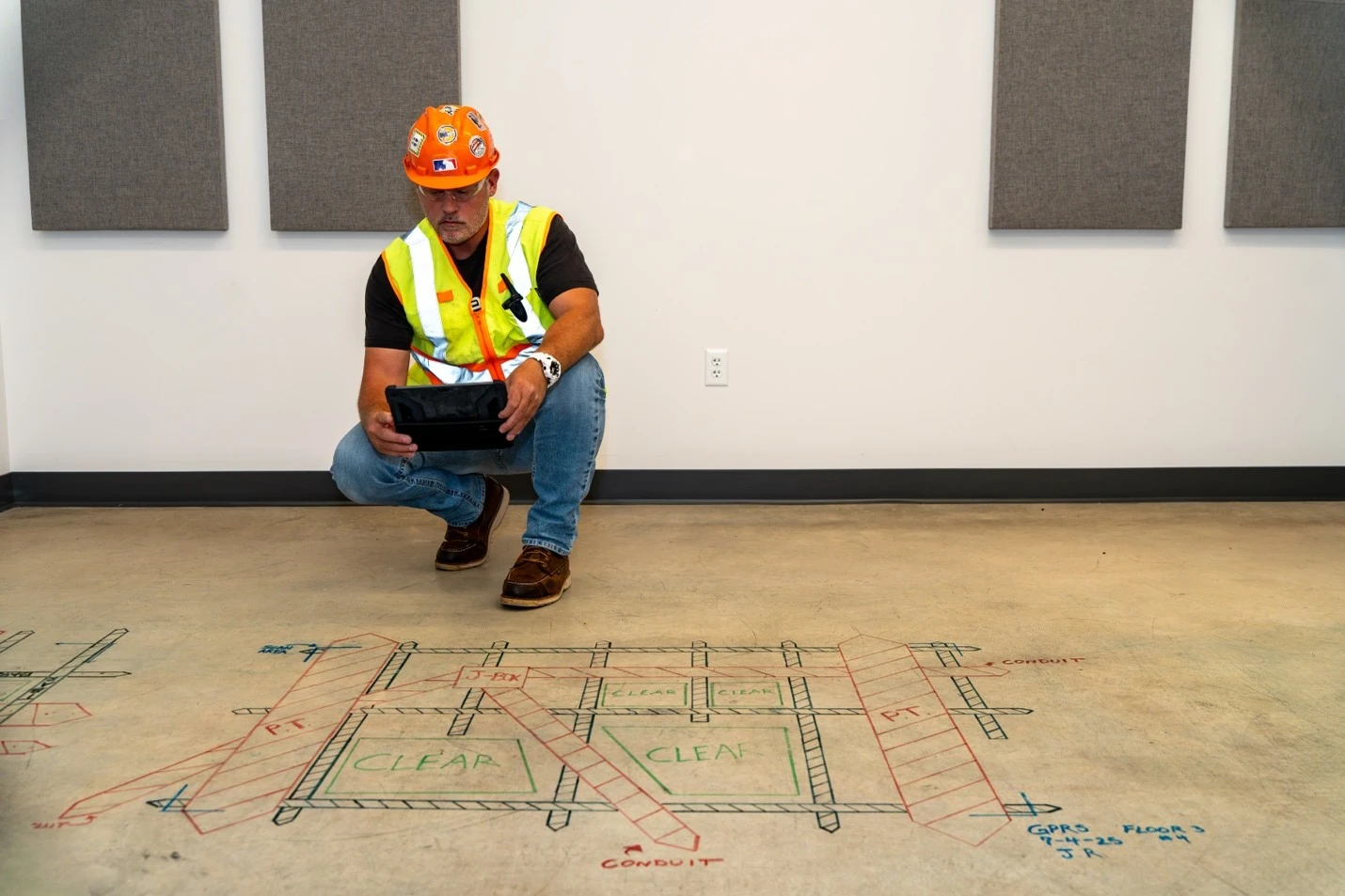
Before performing core drilling or anchoring, contractors rely on concrete scanning to locate embedded objects.
GPR can identify:
- Rebar and wire mesh
- Conduits and pipes
- Post-tension cables (critical to avoid cutting)
- Slab thickness and beam locations
A typical scope of work includes scanning a defined area around planned drill points, marking safe zones, and identifying hazards. This is essential for core drilling, anchoring systems, and saw cutting.
GPR scanning helps you avoid structural damage, injuries, and project delays that could result from striking a post-tension cable
2. Utility Locating Before Excavation
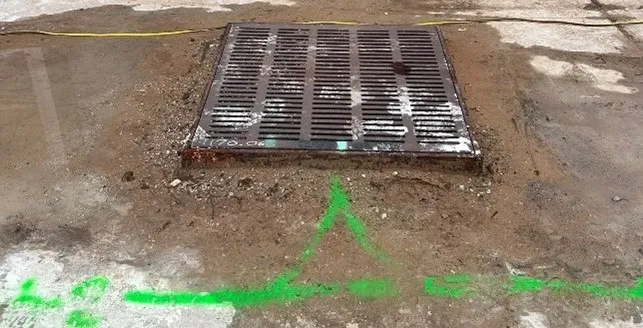
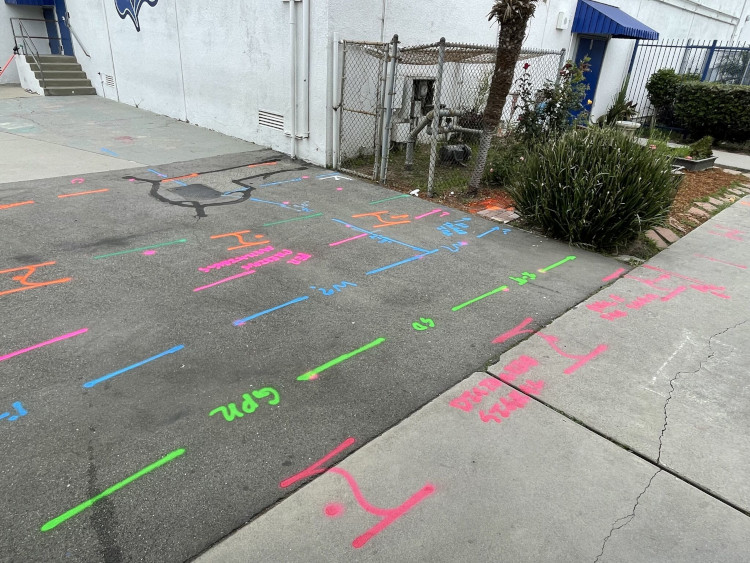
GPR is commonly used alongside electromagnetic (EM) locating tools to trace conductive utilities, identify unknown or undocumented lines, and support comprehensive ground penetrating radar utility locating processes. Unlike public 811 services, which only mark lines up to the meter, GPR helps GPRS locate private electrical lines, water and sewer connections, and communication infrastructure running through privately owned property. This makes it a key component of utility mapping on commercial job sites.
3. Trenching and Directional Boring
For trenching and horizontal directional drilling, depth accuracy is critical. GPR helps contractors identify utilities crossing the trench path, estimate depth to avoid strikes, and plan safer drilling routes. In directional boring, where the drill head is not visible, combining GPR with potholing significantly reduces risk.
4. Integration with Other Services
GPR is often part of a broader subsurface strategy. It works most effectively when combined with video pipe inspection for internal pipe condition assessment, acoustic leak detection tools for locating water loss, and CCTV drainage surveys that confirm external soil and pipe conditions. For example, a water leak detection company may locate a leak acoustically, then use GPR to map surrounding utilities before excavation begins. This layered approach provides a far more complete picture of subsurface conditions than any single technology alone.
What Affects GPR Performance?
GPR is powerful, but it's not impervious to environmental conditions. Its effectiveness depends on several real-world factors.
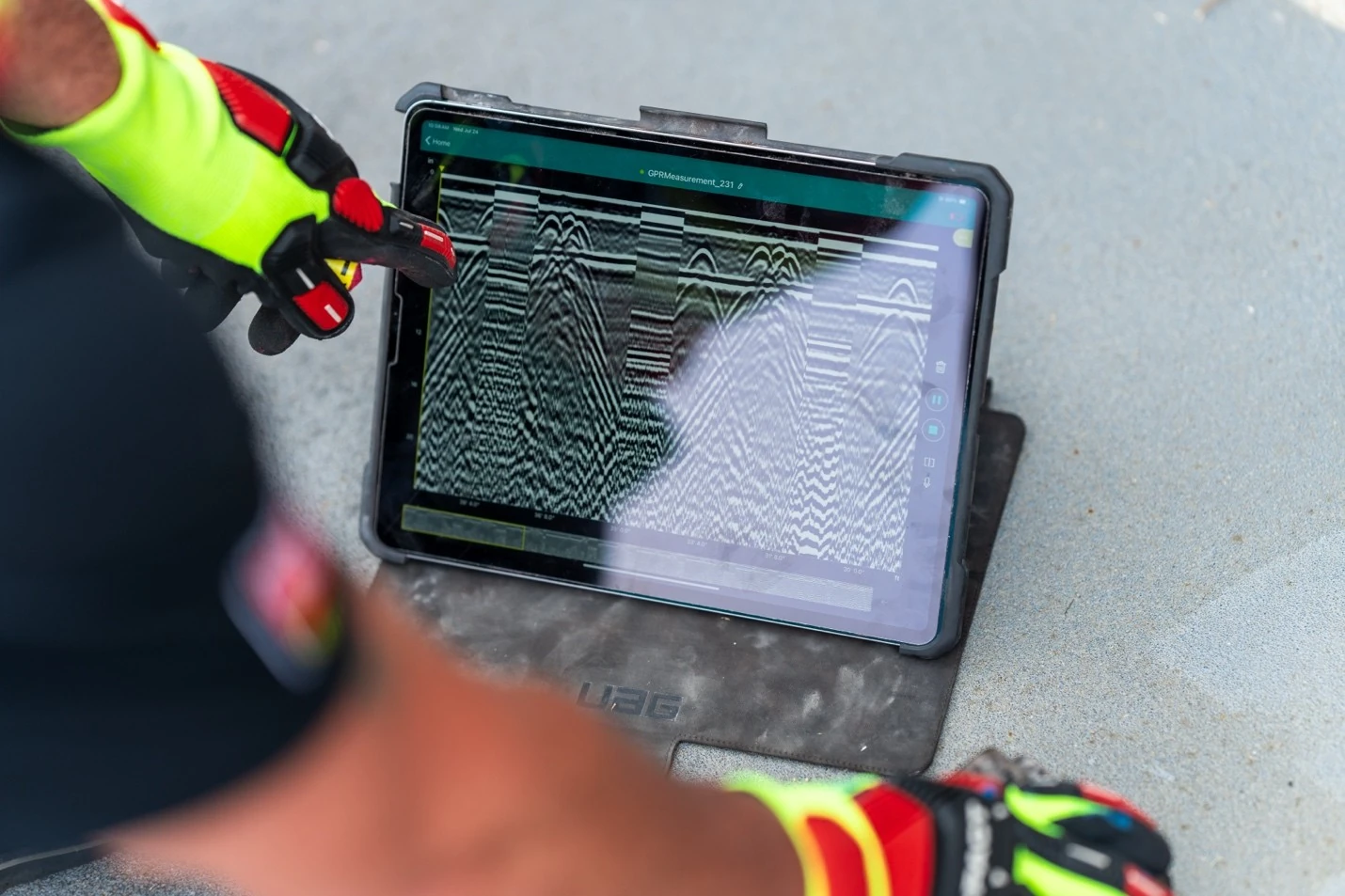
Material Type: Dry sand and concrete allow excellent signal penetration, while wet clay or dense materials reduce signal strength and limit depth.
Depth Limitations: Higher frequency antennas (around 2 GHz) offer better resolution but less depth. Lower frequency antennas (around 400 MHz) reach greater depths but with less detail, making antenna selection a key part of any pre-scan assessment.
Slab Conditions: Thick slabs over 16 inches may require scanning from both sides. Newly poured concrete may limit visibility, and reinforcement like steel fibers can obscure signals.
Surface Conditions: Certain finishes like terrazzo can affect readings. Pan decking and hollow core slabs require special interpretation.
Understanding these limitations is key to using GPR scanning effectively on the job site.
GPR vs. Other Subsurface Technologies
GPR is not a standalone solution. It's part of a toolkit.
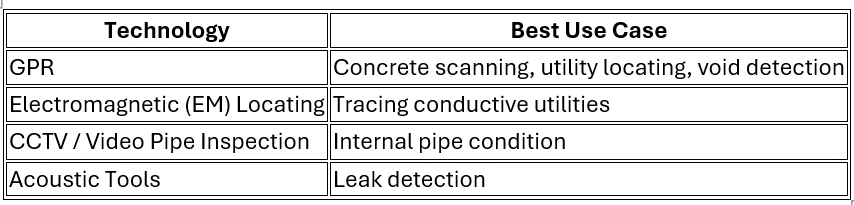
For example, sewer inspection often relies on video pipe inspection, not GPR. Leak detection service providers may use acoustics first, then GPR for mapping. The best results come from combining these methods.
GPR for Modern Contractors: A Competitive Advantage
For newer contractors entering the field, adopting technologies like GPR can set you apart.
- Improved safety: Fewer utility strikes
- Better planning: Accurate subsurface data
- Client confidence: Professional, tech-enabled workflows
- Cost control: Reduced rework and delays
Even if you're not operating the equipment yourself, understanding how GPR works helps you ask the right questions, interpret results, and coordinate better with service providers.
Should You Rent, Buy, or Hire GPR?
When a project requires GPR, contractors generally have three options: rent the equipment, buy it, or hire a professional. Here is what each one costs.
Renting GPR Equipment
Renting a utility locating GPR unit runs approximately $400–$1,750 per month. A handheld concrete scanning unit rents for roughly $1,000–$4,000 per month. Those figures cover the equipment only. A complete utility locate also requires an electromagnetic (EM) locator, which rents for about $700–$1,500 per month, plus a rodder/sonde combination at around $250 per month to detect non-metallic pipes. Renting only makes financial sense if you already have staff trained to operate the equipment and interpret the data. Without that training, the results are unreliable regardless of the equipment.
Buying GPR Equipment
A utility locating GPR unit costs between $14,000 and $100,000 to purchase, depending on features. An EM locator adds $800–$5,000. A rodder adds $975–$3,000. Total average cost to own a full utility locating setup: $65,000, plus training.
For concrete scanning, a handheld GPR unit costs $11,000–$17,000. Add a tablet to read the data and the total system runs up to $15,000, plus training.
Training is a separate cost either way. A basic online GPR course runs about $600 and does not meet minimum industry certification standards. A Level 1 NDT certification requires eight hours of classroom time and 60 hours of field practice, at approximately $1,000 per person per level.
Buying equipment makes sense for companies that do this work constantly and have trained staff to run it.
Hiring a Professional GPR Service
For most contractors, hiring a professional is the more accurate and cost-effective path. GPRS Project Managers are SIM-certified, which requires 80 hours of classroom training and 320 hours of field work. That is more than three times the industry minimum. It is the reason GPRS has maintained a 99.8% accuracy rate across more than 350,000 projects. You get the right equipment for your specific job, operated by someone who knows how to read the results, without the capital outlay or the training burden.
The Role of GPRS in the Industry
Companies like GPRS have built our services around combining GPR with other technologies to deliver full-site visibility. With capabilities spanning concrete scanning, private utility locating, utility mapping, video pipe inspection, and leak detection, GPRS offers a comprehensive approach that aligns with how modern construction projects are managed.
What sets us apart is our use of SIM-certified Project Managers trained under Subsurface Investigation Methodology, the industry's most rigorous standard for subsurface investigation. SIM certification requires 320 hours of mentored field training and 80 hours of classroom work, far exceeding the typical industry recommendation of just eight hours of classroom time and 60 hours of practice.
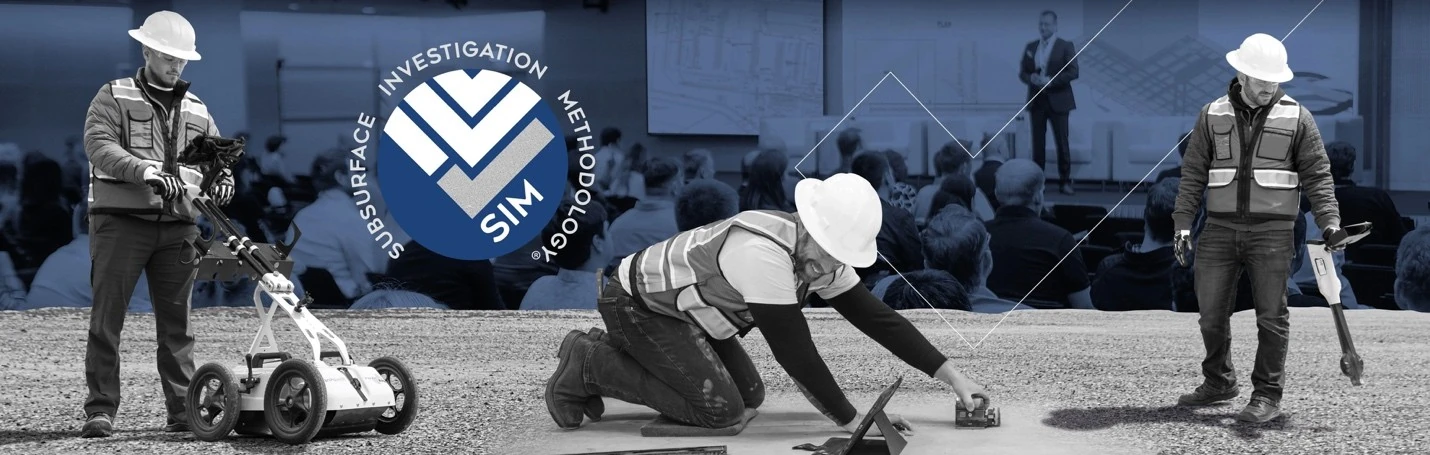
That investment in training is why GPRS has maintained a 99.8% accuracy rate in utility locating since 2017. For contractors, it means fewer blind spots, fewer surprises, and a partner you can rely on when a client asks how you knew the site was safe.
Ground penetrating radar has become a cornerstone of modern construction planning. From concrete scanning to utility locating, it provides the insight contractors need to work safely and efficiently.
Click below to see how GPRS delivers safer, faster workflows for construction professionals.