.svg)

.svg)

The University Medical Center New Orleans, a Level 1 trauma center, was experiencing a steam leak that had puzzled its management team for roughly three months.
It was very important to find the leak using non-destructive methods so none of the medical center’s daily operations were disrupted.

They performed multiple dye tracing tests, which narrowed their search to a 250-linear-foot area. However, they still couldn’t pinpoint its exact position.
The ongoing issues also put the UMC at risk of temporarily shutting down to allow for extensive excavations. Because of this, the problem needed to be solved quickly.
That is where GPRS came in.
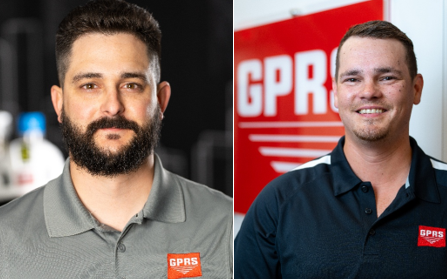
The medical center tasked GPRS Area Manager Steve Carney and Project Manager Justin Soileau with pinpointing the location of the steam leak.
GPRS Leak Detection Project Managers are trained to non-destructively locate leaks in pressurized water pipes. The process of locating a steam leak is no different, as it’s still water but in a different form.
Project Managers listen for leaks using acoustic leak detectors in conjunction with leak detection correlators to provide clients with the most accurate results.
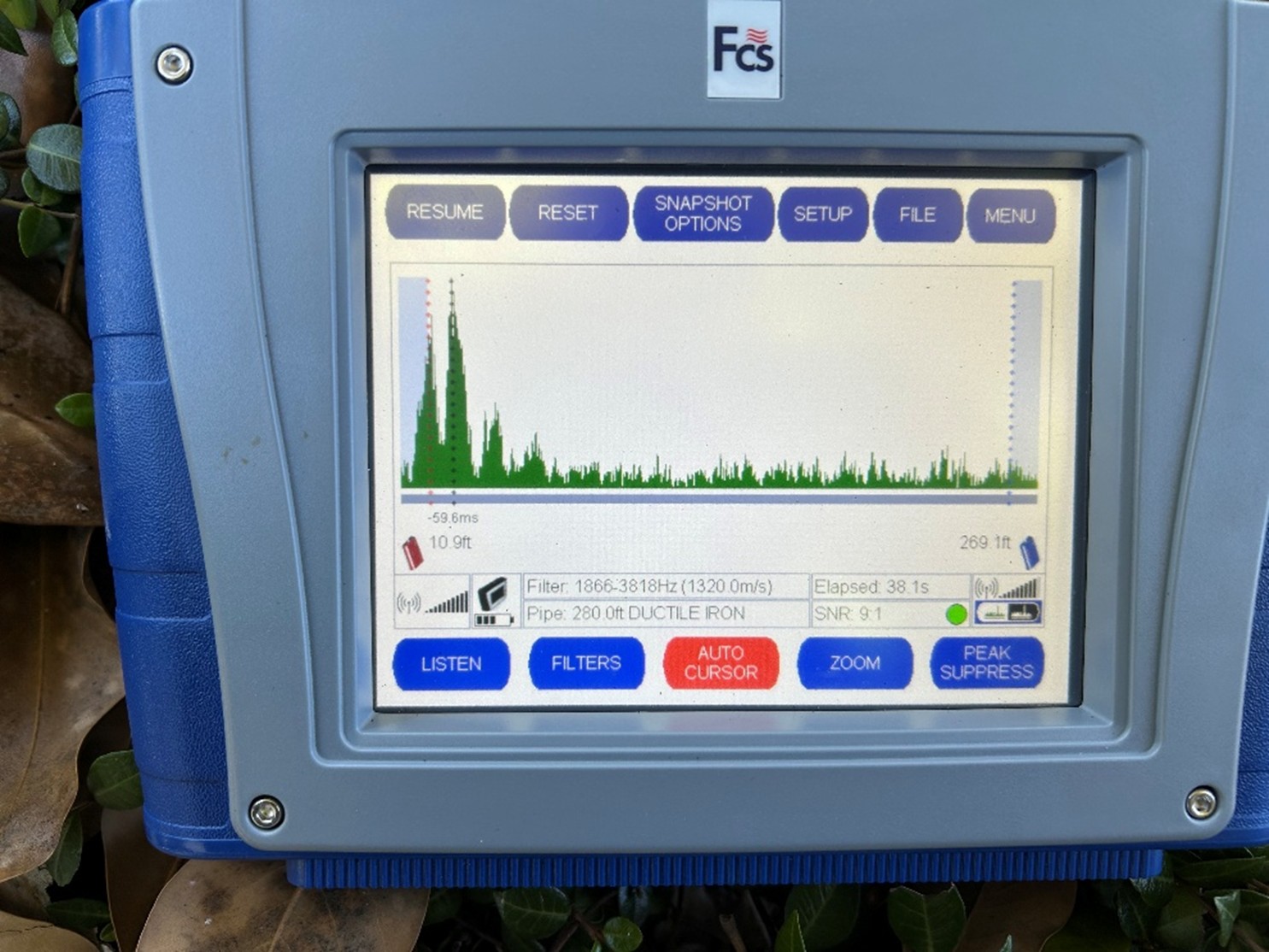
Carney and Soileau worked closely with the medical center to ensure they could access specific areas without interfering with the important work taking place behind the trauma center’s walls.
“The client led us to a pretty deep manhole that we had to get into to listen to the line,” Soileau explained. “And we had to run the correlations through the manhole, as well as inside of the mechanical room in both the buildings.”
Soileau has been with GPRS for over five years and all his time in the field along with his extensive training helped him find the elusive leak.
“This was textbook, as far as the job went,” Soileau explained. “It was super concise. The results of the correlators were perfect. We even matched up the drawings that the client provided to us with the mechanical joint and identified it as one of the failures.”
Once he located the leak, the UMC brought in A&A Mechanical to repair the steam line. To guarantee they could safely dig and not strike any other subsurface infrastructure, Soileau also located all neighboring utilities adjacent to the leak. When digging outside of a hospital, striking an underground utility, like a power or gas line, could cause service interruptions that would be detrimental to the safety of the patients.
Soileau documented his findings by marking the surface with spray paint, taking photos, documenting his results with GPS positioning, and uploading the utility scan data and leak detection report into SiteMap® (patent pending).
SiteMap is GPRS’ cloud-based GIS infrastructure management platform that securely houses our clients’ site data 24/7. Everything from 99.8% accurate utility data to 3D BIM models and NASSCO-certified reports can be uploaded into SiteMap and shared across teams to allow for better communication and smoother project execution.
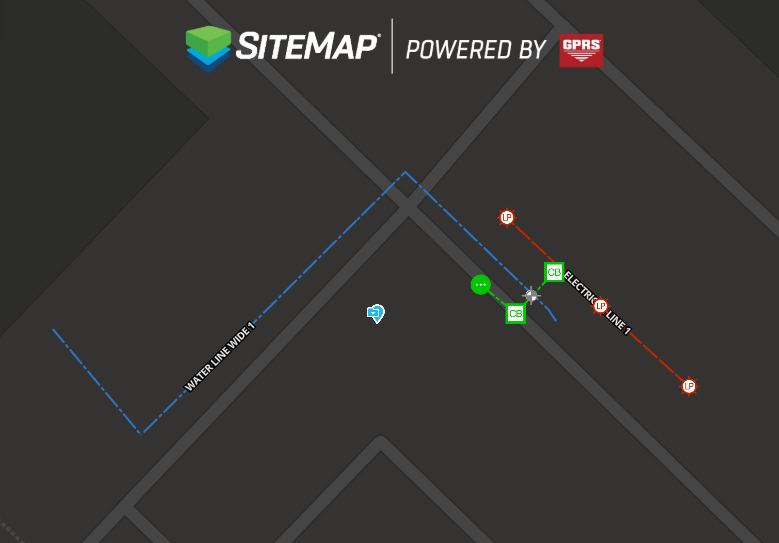
While performing the utility locate, Soileau discovered what he thought was the cause of the steam leak.
“There was a storm line in the area that we suspected was the cause of the issue,” Soileau explained. “The storm line had kind of caved in a little bit, and we believe that the soil that eroded from that may have caused the bend in the mechanical joint on that steam line and created the leak that they were experiencing.”
After delivering his results to A&A Mechanical, Soileau received the following message from an A&A Project Manager after the leak was successfully repaired: “We found that steam leak today. Exactly where you marked it. Great job! 14’ deep.”
Soileau was also very appreciative of Carney’s help throughout this project and wanted to make sure he expressed his appreciation for everything Carney does as an Area Manager.
“I wanted to give a lot of credit to Steve Carney. He wears multiple hats every single day. He was greatly involved in the front end of this, which contributed to a lot of the success of this job.”
From skyscrapers to steam lines, GPRS Visualizes the Built World®, above and below-ground, to make sure your projects stay on time, on budget, and safe.
What can we help you visualize?
FREQUENTLY ASKED QUESTIONS
What is SIM?
Subsurface Investigation Methodology (SIM) is a standard operating procedure and set of professional specifications that work as a guide for utility locating experts when scanning for buried utility lines. All GPRS Project Managers are required to achieve SIM 101 certification, which requires 80 hours of hands-on training in a classroom setting and 320 hours of mentorship in the field. For reference, the American Society for Nondestructive Testing’s (ASNT) minimum training recommendation includes eight hours for training and 60 hours practicing GPR to achieve NDT Level 1 certification in ground penetrating radar (GPR) scanning.
SIM requires the use of multiple, complementary technologies, like GPR scanning and electromagnetic (EM) locating, when locating buried utilities or scanning a concrete slab.
What is an annual leak survey and why do they matter?
An annual leak survey is a scheduled inspection of water infrastructure to identify and document leaks. These surveys are critical for regulatory compliance, environmental protection, and cost control. Regular assessments reduce water loss, prevent hazardous conditions, and extend asset life. For municipalities and facilities, annual surveys support proactive maintenance and budget forecasting.
How long does a leak detection usually take?
How long it takes to find your leak depends on the system size, complexity, and access conditions. A standard survey of a small facility or municipal segment may take several hours, while larger networks can require multiple days.
GPRS optimizes efficiency through pre-survey planning and site walks, real-time data collection, and advanced equipment, minimizing disruption and ensuring timely reporting.
Schedule GPRS leak detection services here.
Can GPRS determine the size of a detected leak?
GPRS determines the size of the leak by how far the leak signal travels between contact points and the pitch of the tone received.
GPRS does not, however, produce formal leak estimations.