.svg)

.svg)

GPRS’ 99.8% accurate underground utility and concrete scans, along with millimeter-accurate 3D laser scans, provided an electrical contractor with the confidence to conduct infrastructure upgrades at a substation.
An electrical contractor was selected to upgrade the overhead feeder lines into the substation along the main access road, requiring the replacement and relocation of utility poles.
They required a full-site 3D visualization of above and below-ground conditions.
The scope included as-builts of the pole locations, overhead lines, and nearby infrastructure, as well as interior scans of the on-site office building.
The electrical contractor also needed to perform tie-ins inside the office building and had no existing as-builts of conduit, rebar, or post tension cables inside the mechanical and storage rooms.
That’s where GPRS came in. GPRS Project Manager Matthew Caerulius completed two days of utility locating across this 127,000 square feet jobsite.

“I conducted utility locating [on the first day], which we started with the front parking area and the roadway that heads up to the main road,” Caerulius explained. “I started scanning there and focused on that area plus the connecting road to the main yard where the electrical building is located.”
Caerulius utilized ground penetrating radar (GPR), electromagnetic (EM) locating, and a traceable rodder to identify and mark underground utilities across the site.
As with all GPRS Project Managers, he is trained in Subsurface Investigation Methodology (SIM). SIM is a standardized operating procedure and set of professional specifications that guide the utility locating process for buried infrastructure. SIM sets the required field standard for all GPRS Project Managers and Field Team members.
This methodology ensures consistent results and supports GPRS’ industry-leading 99.8% accuracy rate across hundreds of thousands of scans.
.webp)
Then, after the snow melted, he re-marked the utilities on day two to maintain clear reference points for the 3D laser scanning scope.
As a next step, Caerulius located utilities throughout the main yard surrounding the electrical building. He noted, “What stuck out to me was a large amount of the electrical network we picked up from that main building. There were a lot of connecting lines.”
That level of underground congestion highlighted how critical 99.8% accurate utility data was to prevent conflicts and keeping the client’s upgrade work on track.
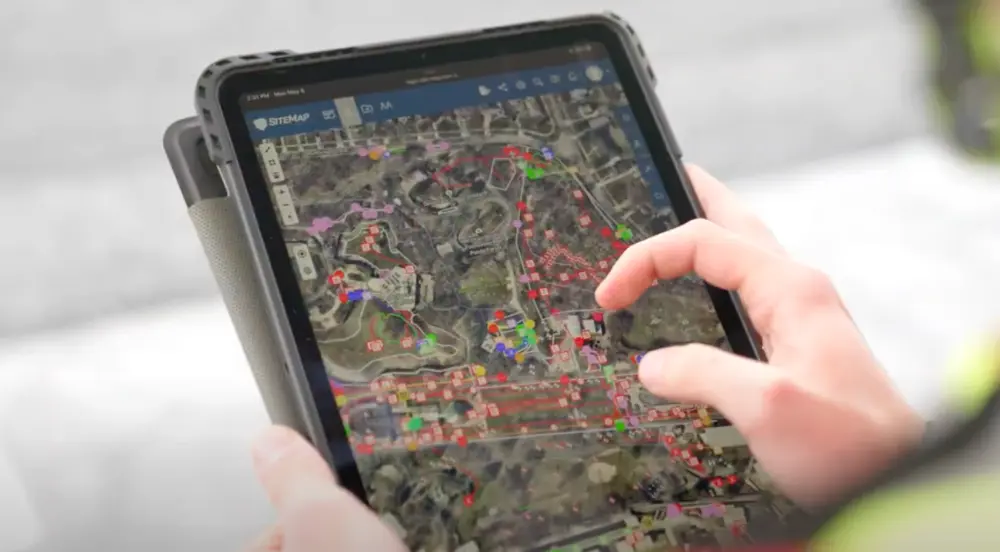
To keep a permanent record of the temporary utility markings, Caerulius used GPS positioning to create a digital map of his findings and uploaded the data into SiteMap® (patent pending) so the client could access it right away.
.webp)
On day three, concrete scanning and reality capture were completed, covering 127,000 square feet of bare earth, structural features, aerial infrastructure, and existing powerlines. Color laser scanning delivered high-resolution point clouds that clearly documented utility markings and site details, enabling accurate interpretation and confident decision-making.
For the reality capture scope of work, Remond and Blake were tasked with utilizing multiple terrestrial 3D laser scanners to scan across the long road to the main highway.


Remond used a long-range 3D laser scanner to keep the scan data level across the vast jobsite.
This LiDAR laser scanner captured detailed information about the ground in a georeferenced point cloud, including grassy areas and hills. “So, the [long-range scanner] kept everything level, and captured longer, more accurate [measurements] over the longer distances,” said Remond.
This technology enables precise elevation mapping and realistic surface modeling, even across complex terrain, providing a comprehensive digital representation of existing site conditions.
%20(3).webp)
These scans were in color, allowing the contractor to see the utility markings on the ground.
“So, it was a unique project where I was working directly with [Caerulius] to coordinate with him where he needed to touch up lines, and what lines were still good to scan. My role with the laser scanner was to precisely document where the utility lines were,” explained Blake.
Caerulius used ground penetrating radar (GPR) to conduct a concrete scan of the office building and visualize conditions within and beneath the slab-on-grade.
Once the concrete scanning was finished, Blake performed colorized 3D laser scans to document the concrete markings.
He stated, “I just had to lower the scanner to make sure I was seeing under there. Some of the markings went under the table. So, I had to make sure I was getting scans at different angles.”
To capture the full extent of the markings, Blake adjusted the scanner’s position differently than he would for a standard architectural scan to obtain clear visibility of the floor and ensure full coverage of all the marked areas.
As Blake explained, “I made sure I backed up and put the scanner in a spot where it would see the ground from the previous spot, just so that there weren’t any holes in the floor’s data.”
Thanks to GPRS’ comprehensive visualization services, both above and below-ground, the electrical contractor prevented costly overruns, saved time, kept their workers safe, and avoided subsurface damage during construction.
From substations to subsurface mapping, GPRS Visualizes the Built World to keep your projects on time, on budget, and safe.
What can we help you visualize?
Frequently Asked Questions
What deliverables are part of a GPRS utility locate?
A GPRS utility locate can include field markings, flags, and digital records of the utilities located on site. The common deliverables include complimentary PDF and KMZ utility maps, depths where possible, along with georeferenced utility data via the SiteMap GIS platform and mobile app. You can also export, share, print, or download 2D CAD drawings, and 3D BIM or conceptual models from GPRS’ Mapping & Modeling Team.
See how GPRS converts 99.8% accurate utility locate data into georeferenced, shareable deliverables that support excavation planning, site coordination, and enhance jobsite safety, here.
What is the difference between GPR and EM locating?
GPR and EM locating find underground utilities in different ways. GPR uses radar to detect subsurface elements underground or within a surface, while EM locating detects the electromagnetic signals from pipes and cables. GPRS’ SIM-certified Project Managers often use both methods together, with each technology used to verify the other and confirm the accuracy of the findings.
Learn more in Utility Locating: Electromagnetic Locating, Utility Locating Services Explained, GPR Explained, and SIM Explained.
How long does 3D laser scanning take?
Most on-site 3D laser scanning takes a few hours to a few days, while large campuses or facilities can take longer. The schedule depends on the size of the site, the required scan density, line-of-sight conditions, and the deliverables needed after capture, such as point clouds, 2D CAD drawings, 3D BIM models, or virtual tours. We define the scope first, capture the site with LiDAR-based scanners, and then process the data into the formats your team needs for planning, design, and coordination.
Learn more about GPRS’ 3D Laser Scanning Process, here.
What is at-depth modeling?
At-depth modeling is a Revit-based 3D model that depicts subsurface utilities and concrete obstructions at their measured depths below the surface. GPRS’ Mapping & Modeling Team creates at-depth structural and subsurface 3D models with utility locating, concrete scanning, and 3D laser scan data, so you can understand how below-ground conditions relate to the site above. GPRS’ Project Managers locate subsurface features with GPR and EM and capture site geometry with LiDAR. Then, GPRS’ Mapping & Modeling Team converts those findings into an integrated 360° visualization that is accessible via SiteMap.
Learn more about At-Depth Modeling and how it can help your project, here.