.svg)

.svg)

What is the Fourth Industrial Revolution?
According to IBM, Industry 4.0, or the Fourth Industrial Revolution, is “the realization of the digital transformation of the [manufacturing], delivering real-time decision-making, enhanced productivity, flexibility, and agility to revolutionize the way companies manufacture, improve, and distribute their products.”
The digital wave doesn’t just affect the manufacturing industry, it also impacts the Architectural, Engineering, and Construction (AEC) industry.
“In response, forward-thinking firms are increasingly adopting new tools to remain competitive in an ever-changing landscape,” states Sandesh Joshi, Founder & CEO of Indovance Inc.
For GPRS’ customers, the practical meaning is straightforward. You need digital as-builts of your building or facility to outsmart the unknowns and keep your projects moving.
The answer is to create a digital foundation that begins with accurate, accessible as-built drawings, 3D BIM models, and 2D CAD maps. Advanced tools such as Internet of Things (IoT) sensors, artificial intelligence (AI) analytics, and digital twins deliver full value only when accurate project information is available at your fingertips.
When it comes to the AEC industry, this means moving beyond traditional methods and adopting reality capture deliverables. Technologies like 3D laser scanning and BIM modeling link the physical and digital worlds. Digital data is a key component of Industry 4.0 because it enables better planning, fewer surprises, and informed decision-making. Read on to learn how to build that foundation and stay on the cutting edge of the latest Industrial Revolution.
What is the History of Industry 4.0?
Industry 4.0 did not appear overnight. It’s the newest chapter in a long story of industrial modernization. Manufacturing shifted from manual craft to mechanized power, and then mass production moved to programmable automation. Now, manufacturers use cyber-physical systems, also known as cybersecurity, to link assets, data, and decisions in real time. This timeline explains how today’s transformation focuses more on building reliable maps, models, and user-friendly data than on purchasing faster machines.
The First Industrial Revolution: Mechanization and Steam Power
The late 18th and early 19th centuries introduced mechanization through water and steam power, which enabled factories to scale output beyond human and animal labor. Steam engines and mechanical looms changed handmade work into high-volume machine production. Finished goods could now be made with much less manual labor.
The Second Industrial Revolution: Electricity and Assembly Lines
By the late 19th century, the Second Industrial Revolution introduced the use of oil, gas, and electric power, along with assembly lines.
- Electricity replaced steam
- Oil started a transportation and logistics revolution
- Henry Ford’s automotive production model reduced production times and costs
This period also marked the rise of standardized processes and global trade expansion, driven by the widespread adoption of cars, ships, and airplanes.
The Third Industrial Revolution: Digital Technology and Automation
The Third Industrial Revolution, also known as Industry 4.0 or the Digital Revolution, began in the middle of the twentieth century. Unlike the first two revolutions, which depended on mechanical and electrical energy, digital technology changed the game in Industry 3.0. Programmable logic controllers (PLCs), robotics, and early automation systems allowed factories to achieve precision and continuous digital data management. This era also saw the rise of computer-aided design (CAD) and manufacturing.
The main technologies of Industry 3.0 included:
- Personal computers (PCs)
- Industrial robots
- CNC systems
- Computer networks
The Fourth Industrial Revolution: Artificial Intelligence, Digital Twins, and the Internet of Things
The Fourth Industrial Revolution, currently known as Industry 4.0, started in the early 21st century. This revolution does not focus on a single technology. Instead, this era combines many fields like physics, digital technology, and biology. This mix creates a new way to make and use products. The system is smart, connected, and can work on its own using tools like artificial intelligence (AI), the Internet of Things (IoT), and cloud computing.
What Are the Components of Industry 4.0?
Industry 4.0 includes several core technologies that work together to create smart, connected, and efficient systems.
What Part Does The Internet of Things (IoT) Play?
The Internet of Things (IoT) is a big part of what makes smart factories tick. Picture this – the factory floor machines loaded with sensors, each having its own IP address, so they can connect to other web-enabled devices with ease.
- Benefit: Helps monitor equipment and reduce downtime
Cloud Computing
Cloud computing is a cornerstone of Industry 4.0 because it links engineering, supply chain, production, sales, and service. The cloud stores and processes large amounts of data fast and at a lower cost.
- Benefit: Cuts IT costs and scales with business growth
The Role of Artificial Intelligence (AI) and Machine Learning (ML)
Artificial Intelligence (AI) is essentially a machine’s ability to perform cognitive functions we usually associate with human minds – things like perceiving, reasoning, learning, interacting with the environment, solving problems, and even showing creativity. Chances are, you’ve already interacted with AI without realizing it. Voice assistants like Siri and Alexa? Powered by AI. Those helpful chatbots that pop up on websites? Also, AI at work.
Now, machine learning, a branch of AI, takes this concept further by enabling systems to learn from data, identify patterns, and improve over time through experience rather than explicit programming.
Deep learning pushes the boundaries even more, using neural networks inspired by the human brain to process images, text, and audio.
.webp)
- Benefit: Boosts efficiency and prevents costly breakdowns
Edge Computing
Edge computing analyzes data at its source or “edge,” which eliminates delays and enables immediate action when safety or quality issues arise with manufacturing equipment. This component keeps data close to its origin, which reduces exposure and strengthens security.
- Benefit: Enables real-time decisions and improves safety
Cybersecurity
Industry 4.0 connects machines and systems across the factory floor, creating a highly integrated environment. This level of connectivity introduces potential entry points for attacks and malware. Cybersecurity protects IT infrastructure and operational equipment from threats and minimizes risks.
- Benefit: Reduces the risks of cyberattacks and keeps operations secure
Digital Twin
3D BIM models developed by GPRS can serve as the base for a digital twin, which is an exact virtual representation of a physical space that uses real-time data to stay updated and accurate. By using Internet of Things (IoT) sensors, the model of the space can continuously update with high accuracy.
- Benefit: Lets you test ideas and optimize workflow without stopping production
How Is 3D Laser Scanning Used for Industry 4.0 in AEC?
Why it Matters
According to ScienceDirect, “In Industry 4.0, 3D [laser] scanners are helpful for designing, assessing the minor features of any product, capturing freeform, and providing precise point clouds for complicated geometry and curved surfaces.”
.webp)
These details create 3D BIM models. They power digital twins, as mentioned before, aid in making informed predictions, and automate systems. Without this technology, firms would struggle to stay connected and work at the level of efficiency required by Industry 4.0.
Key Applications
1. Industrial Design: LiDAR-based 3D laser scanning technology is prevalent in the AEC industry. Before 3D laser scanning, interns would take measurements in the field with the use of graph paper, pencils, and tape measures. The “old ways” of taking measurements were very time-consuming and labor-intensive.
2. Assisting Architects/Building Site: Architects and builders leverage 3D laser scanning to capture exact details of a building. A 3D laser scanner is set up on location and collects millions of data points at X, Y, and Z coordinates. Modeling software, like Autodesk Revit, turns this field data into a complete digital 3D BIM model.
3. Create Virtual Environment: 3D laser scanners create digital spaces, like TruView virtual site visits for visualization. These environments help teams test ideas and take measurements fast without a physical presence on site.
4. Artificial Intelligence and Machine Learning: Artificial intelligence (AI) is growing in many industries and has the potential to improve the capabilities of 3D laser scanning systems. These technologies support greater accuracy, faster decision-making, and streamlined workflows. Recent advances in machine learning (ML) show strong potential to automate point cloud processing and produce accurate as-built models.
Benefits of 3D Laser Scanning
- Speed and Accuracy – Captures millions of data points in seconds
- Cost Savings – Cuts rework and material waste
- Flexibility – Applies to many industries, including healthcare and automotive
- Collaboration – Connects global teams with shared digital models
- Sustainability – Reduces waste and optimizes resources
Reasons to Use GPRS to Stay Ahead of the Curve
Industry 4.0 depends on precise, connected information. Before Internet of Things (IoT) sensors, augmented reality (AR) workflows, or artificial intelligence (AI) analytics can deliver value on a campus or jobsite, project teams need verified maps and models that reflect above and below-ground conditions.
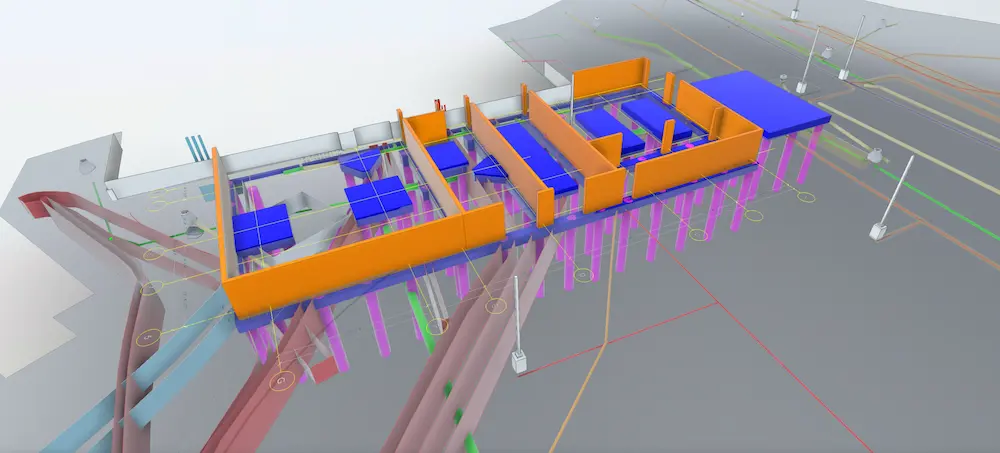
GPRS addresses this with utility locating, concrete scanning, and consolidating field data into SiteMap®, a single, geolocated source of truth available 24/7 from any device. This foundation reduces clashes, rework, and helps keep your projects on time, on budget, and safe.
The SiteMap Reality Capture Layer stores all your 3D laser scan data in one secure platform. This includes 3D point clouds, virtual walkthroughs, and BIM models. The Reality Capture Layer accelerates planning, design coordination, and maintenance across distributed campuses and facilities.
You can learn more about the SiteMap Reality Capture Layer here.
Augmented Reality for Visualizing Infrastructure
According to Innoarea Projects, “Virtual Reality (VR) and Augmented Reality (AR) are two essential technologies for the transition to Industry 4.0, as they enable industrial companies to embark on this path towards digitalization.”
Augmented reality is coming to SiteMap 3.0 in early 2026, available via your mobile device. Soon, you’ll click on a map and drop into a real-world view, like Google Street View, built for your jobsite.
.webp)
You can tap an item to explore deeper and watch a sewer inspection video, see animated flow arrows, or review maintenance history – all in augmented reality.
A “tabletop mode” will also become available.
So, you and I could be sitting at a table across from each other, both on our phones, and looking at the entire sewer system for a city on the table in front of us,” said Jason Schaff, Chief Strategy Officer & Product Executive – SiteMap.
Stay tuned for the launch in early 2026.
And augmented reality (AR) is just the beginning. After its launch, “My Buildings” will redefine how you manage your site.
.webp)
You’ll be able to pick your boundaries, draw a line around a certain segment, assign names to buildings, and click a building to unlock the deliverables.
Stay tuned for the launch in 2026.
3D BIM Models to Digital Twins
Every digital twin begins with a 3D BIM model. Our Mapping & Modeling Team turns raw point cloud data from 3D laser scanning into detailed 3D BIM models, which are the backbone for Industry 4.0 workflows.
Point clouds provide millions of precise measurements of your site and capture every detail. Our team uses the point cloud data to build intelligent BIM models. The models include geometry, asset attributes, and spatial relationships. As mentioned before, they are then integrated into SiteMap, along with a wealth of tools to help you gain a better understanding of your built world. Some of these tools include first-person point of view, measuring tools, explode, media browser, and more.
You can learn more about BIM models vs. Digital Twins here.
Industry 4.0 starts with accurate 3D BIM models and 2D CAD maps.
Start building your foundation today to stay on the cutting edge. The sooner you get your accurate 3D BIM models and 2D CAD maps, the sooner you unlock the full potential of Industry 4.0.
What can we help you visualize?
Frequently Asked Questions
What is the first step toward Industry 4.0 for my facility?
Start by building your foundation with accurate maps and models. GPRS provides utility locating, concrete scanning, and reality capture services to eliminate unknowns and keep your projects running on time, on budget, and safe. From there, our Mapping & Modeling Team delivers above and below-ground documentation – all to SiteMap, preparing your facility for digital twins and Internet of Things integration.
Why are BIM models critical for Industry 4.0?
BIM models are the backbone of Industry 4.0 because they provide structured, data-rich 3D representations of your facility. These models enable the creation of digital twins, which power real-time monitoring, simulation, and predictive maintenance. GPRS’ Mapping & Modeling Team turns point cloud data into precise BIM models. They then integrate these models into SiteMap for streamlined collaboration.


.avif)