.svg)

.svg)

Outdated substations and distribution systems pose a serious risk across today’s grid.
A single equipment failure can trigger a cascade of outages that disrupt entire regions. According to Construction Dive, damage to buried utilities imposes more than $61 billion per year in waste and excess costs on communities.
Meanwhile, demand continues to surge. The U.S. Department of Energy (DOE) and the Lawrence Berkeley National Laboratory (LBNL) report that data centers used about 4.4% of U.S. electricity in 2023. They might consume around 6.7% to 12% by 2028.
The Energy Information Administration (EIA) reports that transmission spending has nearly tripled since 2003. Meanwhile, distribution investment has increased by about 160% through 2023.
DOE’s GRIP selections are directing about $2 billion to 38 projects. These projects will strengthen the U.S. power grid against extreme weather. They will also lower costs for communities and increase capacity.
What is the Power Delivery Project Landscape?
Rising Electric Demand in Power Generation
The power generation market is changing. Rising electric demand comes from electrification, new manufacturing, and data centers. Trends highlighted in the DOE 2024 GRIP program briefings and EIA data show that utility capital spending has experienced consistent growth over the last two decades.
According to DOE, “U.S. electricity demand is projected to account for data center expansion and the rise of artificial intelligence (AI) applications, domestic manufacturing growth, and electrification of different industries. DOE has anticipated this growing demand trend — it reflects robust industrial investments in America and national leadership on technology innovation.”
Despite these shifts, the portfolios are still a hybrid mix of nuclear, hydro, gas, coal, geothermal, and renewables.
Transmission Expansion and Uprates
Utilities and RTOs/ISOs focus on swapping conductors in busy corridors. They also work on line uprates and adding some new routes, which helps meet higher loads, connect renewables, and improve resilience.
Under Federal Energy Regulatory Commission (FERC) Order No. 1920, regions use a 20‑year outlook with clear cost‑sharing rules and a tighter project‑selection process. The goal is to pick the builds that prove they deliver value.
What “value” looks like under the rule:
- Production cost savings
- Low congestion on key paths and interfaces
- Lower loss‑of‑load risk or a smaller planning reserve margin for the same reliability target
- Stronger performance in extreme weather events
Plus, there are other measured benefits like reduced electrical losses and better transfer capability across regions.
Substations and Grid Reinforcement
New transformers, switchgear, voltage support, and station rebuilds are being added across many systems. This work helps reduce congestion and integrate storage.
As previously mentioned, and according to ENR Future Tech, “DOE announced Oct. 18 nearly $2 billion for 38 projects in 42 states and the District of Columbia that will shore up the U.S.”
Recent federal awards focus on marquee transmission projects. These include almost 1,000 miles of lines and 7,100 MW of capacity. State plans, such as California ISO's (CAISO) portfolio, call for bus upgrades, new 500 kV yards, and series/reactor work tied to renewables and offshore wind.
Distribution Modernization and Undergrounding
Utilities at the distribution level focus on:
- Covered conductors
- Segmentation to isolate faults quickly
- Feeder rebuilds
- Underground installation in high-risk corridors
The Underground Transmission and Distribution Lines report from Energy.gov shows that, as of 2023, around 20% of distribution line miles are underground. This is an increase from about 18% in 2009.
Underground transmission at ≥200 kV still accounts for under 0.5% of total mileage.
The underground and overhead split helps teams focus on cost, schedule, and constructability. The split guides their decisions on where to dig and where to stay overhead.
Renewable Interconnections and Offshore Wind
ISO New England’s March 2025 screening shows the region can handle about 9.6 GW of offshore wind. This means it could fit around eight 1,200-MW projects without needing new transmission. However, this requires placing projects at the most suitable substations.
About 38% of major coastal substations evaluated may accept a 1,200 MW injection with no thermal upgrades. A smaller subset could host ~2,000 MW without add-ons.
To cut network costs, ISO-NE suggests moving some points of interconnections (POI) southward from Maine to Boston. They also mention that North-South interface reinforcements will still be necessary as electrification and northern generation growth increase flows.
The findings come from an N‑1 DC thermal steady‑state screen, which is useful for prioritizing POIs. However, stakeholders will still need full interconnection studies to ensure safety and reliability.
Emergency Restoration and Resilience Programs
Post-disaster work in wildfire areas now combines quick rebuilds with undergrounding and system hardening. This helps lower ignition risks and shorten outage times.
In January 2025, 14 major wildfires hit the Los Angeles area and San Diego County in California.
An article by HeySocal states that “Southern California Edison will install over 150 miles of underground electrical lines as part of a plan to rebuild infrastructure in wildfire burn areas.”
Southern California Edison’s (SCE) rebuild will place distribution lines underground where practical and leverage cutting‑edge technology to lower wildfire risk.
Power Infrastructure Construction Challenges
- Limited Outage Windows: Limited outage windows and reliability coordination requirements compress construction and testing. Seasonal restrictions and NERC-mandated outage processes can lead to schedule conflicts. This may delay energization for multiple parties.
- Tight Tie-In Tolerances: Tight tie-ins to existing bus, pipe, or cable allow little room for mistakes. Even a millimeter of misalignment can lead to rework, longer outages, and failed QA.
- Unknown Embedded Conditions in Older Structures: Expect hidden duct banks, rebar, grout pads, sleeves, and patchwork repairs to surface only at demolition or coring.
- Wildfire and Extreme Weather: Wildfires and extreme weather in transmission corridors raise outage and safety risks.
The Western Fire Chiefs Association states that “Between 2016 and 2020, electrical power networks caused 19% of the wildfires that occurred in those five years. With the growing risk of wildfires amid climate change, there is heightened concern about electrical power conductors igniting wildfires.”
- Quality and Rework: One of the most hidden, expensive costs in construction is rework. Inaccurate as-built data can lead to costly delays and change orders.
Autodesk states that “poor project data and miscommunication on projects is responsible for 48% of all rework in construction in the U.S.”
How Can GPRS Support Your Power Delivery Projects?
From generation to the last mile of distribution, power delivery projects succeed when teams have accurate, field‑verified information, both structural and subsurface. GPRS delivers that clarity for your projects with reality capture, utility locating, concrete scanning, NASSCO-certified video pipe inspection (VPI), and leak detection. And with SiteMap®, our secure cloud-based infrastructure management platform, you gain 24/7 access to all drawings, models, utility maps, and deliverables in one place.
Electric Utilities and their subcontractors are constantly looking for asset verification to help with their projects. Front end, GPRS has been proven over and over to help with the design of the projects, from underground utility identification to LiDAR and creating a BIM model for a substation or power plant. Once GPRS captures the existing conditions, all the information can flow down the construction pipeline into the execution phase of the project. Again, the findings and field markings can be updated with accurate information to help mitigate risk for line strikes or change orders. The ROI GPRS provides pays dividends throughout the entire life cycle of a construction project. – Curtis Hoag, Market Segment Leader – Power
Utility Locating
GPRS’ 99.8% accurate utility locating services give your team subsurface certainty across power plants, transmission corridors, substations, and distribution streetscapes. GPRS Subsurface Investigation Methodology (SIM)-certified Project Managers combine ground penetrating radar (GPR) and electromagnetic locators (EM) to identify public and private utilities, abandoned lines, and unknowns before excavation or horizontal directional drilling (HDD). Our field‑verified utility maps and depth data help you avoid redesigns, relocations, and utility strikes that disrupt limited outage windows and tight tie‑ins. You can learn more about GPRS Utility Locating services here.
Concrete Scanning
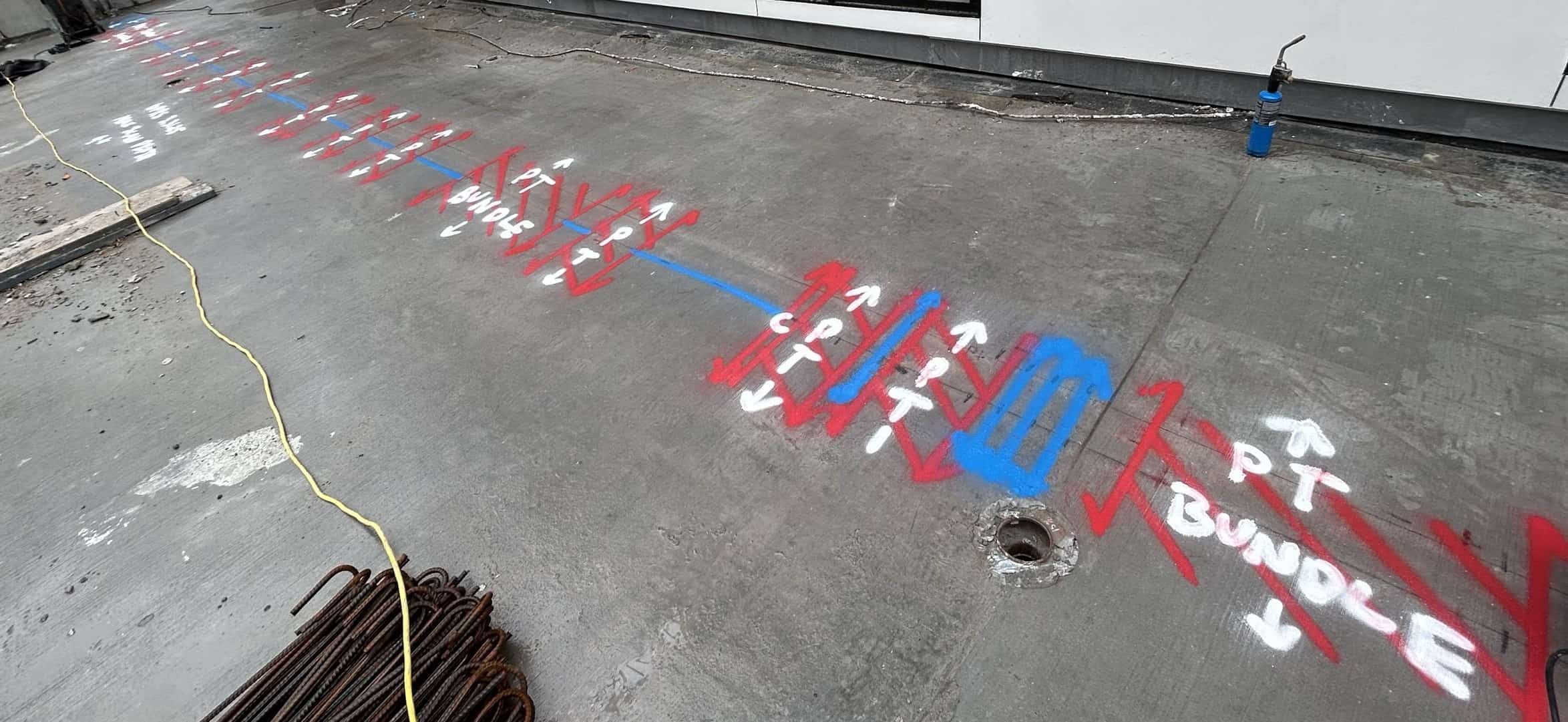
GPRS concrete scanning services remove risk from coring, anchoring, and cutting in generation, distribution, and substation environments. GPRS SIM-certified Project Managers locate rebar, post tension cables, conduits, voids, and embedded utilities. This is done with high‑resolution GPR and complementary detection tools. GPRS’ Mapping & Modeling Team can export scans of the concrete to create accurate as-built models in a format you can easily work with and share with your team. You can learn more about GPRS Concrete Scanning services here.
Reality Capture
LiDAR-based 3D laser scanning produces millimeter‑accurate as‑builts, point clouds, and 3D BIM models. These deliverables power informed design and clearance studies across boiler rooms, turbine decks, and balance-of-plant areas. You receive precise documentation for design changes, clash detection, and informed decision-making throughout the construction and maintenance lifecycle. You can learn more about GPRS Reality Capture services here.
Video Pipe Inspection
Video Pipe Inspection (CCTV), performed by GPRS’ NASSCO‑certified technicians, scopes your sewers to locate clogs, identify cross bores, find structural defects & damages, and conduct lateral sewer line inspections. For power line installations beneath roads and neighborhoods, VPI NASSCO reports help to assess sewer conditions and identify defects. You can learn more about GPRS Video Pipe Inspection services here.
Leak Detection
Power projects often include water‑based fire protection systems and underground process/cooling loops at generation plants and substations. GPRS Project Managers use acoustic leak detection, GPR, and other complementary technologies to pinpoint pressurized water line leak. This helps you know exactly where to dig and fix it. You can learn more about GPRS Leak Detection services here.
SiteMap®
All your structural and subsurface information lives in SiteMap so that your team works from the same, current data set. This GIS-based infrastructure visualization platform stores your utility maps, concrete imaging, 2D CAD drawings, 3D BIM models, NASSCO reports, virtual tours, and more. You can access this data 24/7, from any computer, tablet, or smartphone. You can learn more about SiteMap here.
.webp)
The Benefits of GPRS Data
GPRS provides your team with reliable data. From grounding grid maps and LiDAR 3D laser scans to utility layouts, you can plan, build, and manage with confidence. Turn unknowns into knowns.
Avoid Utility Strikes
99.8% accurate utility locating and mapping of grounding grids, duct banks, and private utilities significantly reduces excavation damage across:
- Substations
- Transmission corridors
- Public right-of-way (ROW)
Reduce Rework
Field-verified as-builts and 3D BIM models from LiDAR 3D laser scanning reduce guesswork. This information helps you with tie-ins and clearances, cutting down on change orders and schedule churn.
Reduce Step‑and‑Touch risk and Outage Time
GPRS maps grounding grids, duct banks, and buried conductors and delivers construction-grade, accurate point clouds. With this information, substation teams plan safe excavations, validate clearances, and execute expansions away from energized equipment.
Prevent Cross Bores
For power line installs beneath roads and neighborhoods, GPRS’ VPI Project Managers document sewer condition and defects to help you prevent cross bores. At power plants, VPI pinpoints internal defects, blockages, and structural issues within pipelines.
Wildfire Risk Management
BIM models are the building blocks of digital twins. Digital twins of overhead transmission lines help prevent wildfires. These digital replicas allow utilities to see the corridor clearly and forecast ignition risk with field‑level precision.
.webp)
Coordinate with the Same Single Source of Truth
SiteMap gives owners, engineering, procurement, and construction (EPCs), engineers, contractors, and stakeholders 24/7 access to GPRS data, both aboveground and below. Let us help you improve collaboration and schedule certainty.
Case Study: GPRS Reality Capture Services Aid in Upgrades to Hydroelectric Dam
GPRS Reality Capture Project Managers captured high-fidelity existing conditions documentation for hydroelectric powerhouses using terrestrial 3D laser scanning to support planned upgrades.
Problem
- Operators of a nearly century-old hydroelectric dam needed precise as-built documentation and 3D BIM models to reduce risks during upgrades
- The dam sits in a remote and rural location
- Each powerhouse spans multiple stories and is densely packed with mechanical and electrical systems
Solution
- A GPRS Project Manager executed comprehensive 3D laser scans of the powerhouses and surrounding infrastructure
- The Project Manager spoke with on-site personnel before scanning to understand the dam’s distinctive infrastructure
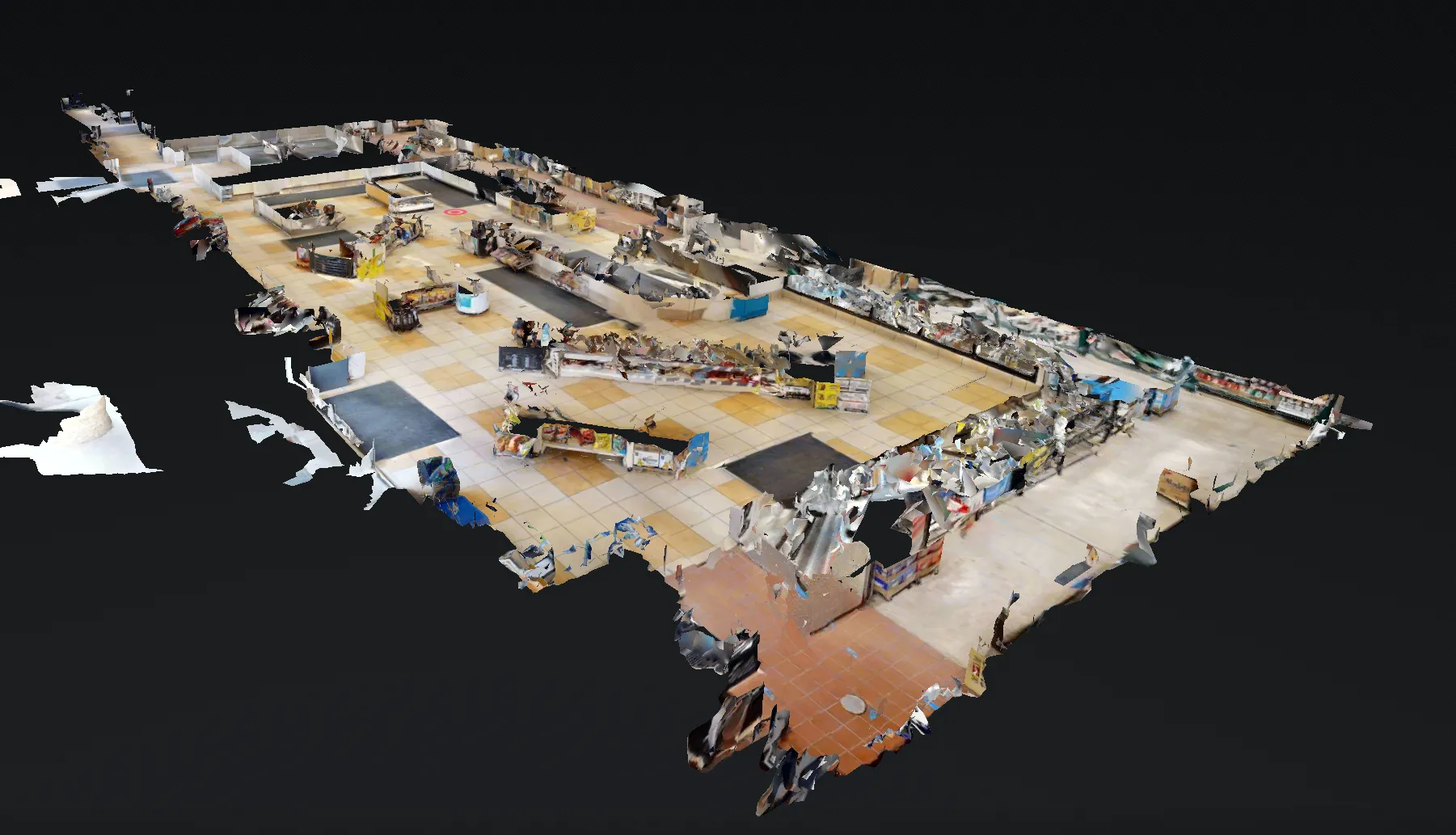
- GPRS' in-house Mapping & Modeling Team registered the scan data and processed it into one cohesive point cloud, then produced a virtual walkthrough, 3D model, and floor plans
Benefits
- Stakeholders plan and design from trusted existing conditions and will be able to limit site visits
- Accurate geometry and documentation will minimize change orders, days, and costly overruns
.webp)
Every GPRS Project Manager is SIM‑certified. SIM is a structured, multi‑technology process honed in the classroom and in the field to produce the best non-destructive results. This methodology directly supports safer excavation and higher fidelity data on your power projects.
Let us help keep you on the grid.
What can we help you visualize?
Frequently Asked Questions
Why is utility locating critical for power delivery projects?
GPRS utility locating services are vital for power projects. A single utility strike can stop work, cause outages, lead to last-minute redesigns, and cause serious injury or even death. GPRS’ 99.8% accurate utility locating services give project teams confidence before excavation or HDD. This helps your team avoid damage to buried utilities that already cost communities over $61 billion per year in waste and excess costs.
How does GPRS support safe construction and upgrades across substations, distribution systems, transmission corridors, and power plants?
GPRS provides a unified suite of subsurface and structural mapping services that reduce risk across every part of the power delivery network. In substations, GPRS locates underground utilities, grounding grids, and duct banks. This helps to ensure safe excavation and prevent strikes in brownfield environments.
Power generation facilities leverage as-built documentation, concrete scanning, 3D laser scanning, and pipeline assessments to support safe construction, design changes, and maintenance in complex, utility‑dense environments.
In transmission corridors, GPRS locates buried utilities and underground transmission lines with 99.8% accuracy to ensure safe tower placement and construction on both public and private properties.
For distribution and undergrounding work, GPRS maps existing utilities, scans concrete, and performs NASSCO‑certified VPI to prevent cross bores and avoid conflicts during pole or duct bank installations.
All data is delivered through the SiteMap. This is your single source of truth for utility maps, CAD drawings, BIM models, WinCan reports, and more.