.svg)

.svg)

Concrete is one of the most thoroughly understood materials in construction. Contractors and engineers have been refining mix ratios, curing times, compressive strength, and other variables for more than a century. But every so often, a problem surfaces that even experienced crews have never encountered before.
That was the situation facing Andersen Concrete after a topping slab was poured on a two-lane bridge in Grove City, Ohio. Crews began noticing cracking and surface imperfections developing in the freshly placed concrete. When they looked closer, the cause was something most people on site had never seen: fiber balls.
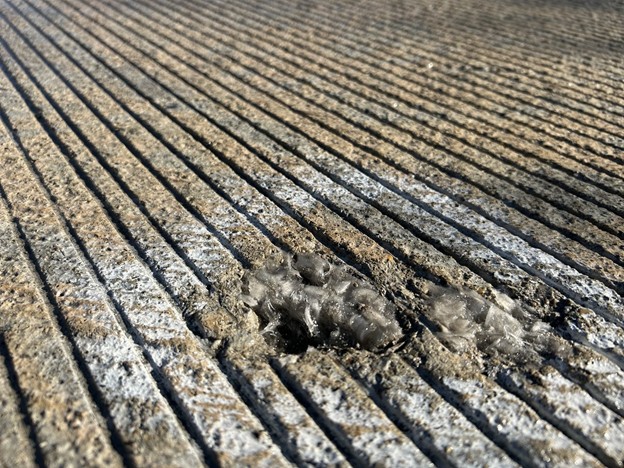
Synthetic reinforcement fibers are a common additive in modern concrete mixes. When properly blended, the fibers distribute evenly throughout the pour, improving tensile strength and reducing cracking. But in this case, the fibers failed to mix properly inside the truck. Instead of dispersing, they clumped together into dense masses that traveled with the pour and became embedded throughout the slab.
“They’re not supposed to clump up into balls,” explained GPRS Project Manager Derrik Clark. “They’re supposed to be all separated.”
Some of the defects had already begun pushing through the surface, visible as cracks and rough patches in the newly finished deck. But the ones already showing were not the real problem.
“The issue is the ones that have not come to the surface yet,” Clark said.

The fiber balls embedded below the surface would continue to migrate upward over time, driven by the natural expansion and contraction of curing concrete and seasonal temperature changes. Each one that broke through would bring cracking and surface damage with it. On a bridge deck, a compromised surface is an especially concerning structural liability because of the strategic role of bridges in the flow of transportation.
Andersen Concrete ran the numbers on their options. Demolishing and repouring the entire topping slab would have been, as Clark put it, “astronomical” in cost. They needed a way to find and remove only the compromised material while leaving sound concrete untouched.
The problem was that nobody could see where the remaining defects were hiding.
Clark had actually encountered this defect once before at a firehouse job just a few weeks earlier. He had scanned that slab and found clusters of anomalies in areas that also showed surface evidence of fiber ball activity. At the firehouse, however, no one cored to verify while he was on site, so he left without direct confirmation that what he’d found were actually fiber balls.
“I did that whole fire department job basically not being 100% sure that I was finding them, but thinking I was, just based on the areas where I was finding more anomalies,” Clark explained. “So that was kind of like a test run.”
On this bridge project, however, there was clear proof of the problem.
Clark used a concrete scanner equipped with ground penetrating radar (GPR) to work his way systematically across the bridge deck.
Unlike a utility locating job, where targets follow predictable linear paths, fiber balls can appear anywhere in the slab, without a pattern and no predictable orientation to follow. Some were isolated. Others appeared in clusters of two or three within a ten-foot section, then nothing for twenty feet, then several more in another concentrated area.
“There’s no rhyme or reason to it,” Clark said.
To account for that randomness, Clark worked in four-inch increments. He scanned a path, took a step, and scanned again, methodically covering the full deck to maximize the chance of detection. The scanner’s capture width is roughly four inches, so any gap in coverage could mean a missed defect.
“It was very strenuous scanning,” he said. “I tried to identify as much as I possibly could for them.”
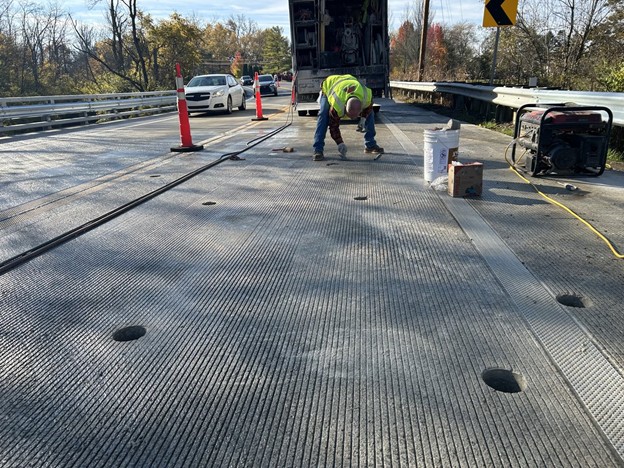
As Clark marked anomalous locations, Andersen Concrete crews followed directly behind him, coring into each flagged spot. Each time they pulled a core, they found a fiber ball. These clumps of synthetic fiber varied in size. The team was able to pull them out of the slab one by one and repair the bridge deck for good.
“When they started coring where I was locating anomalies and pulling out fiber balls, we knew the process worked,” Clark said.
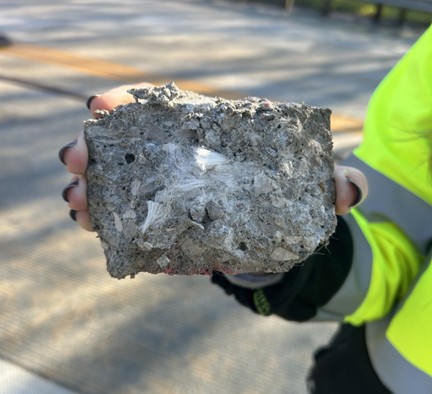
The slab was three inches thick. Everything Clark was scanning for existed within that narrow window. Crews cored the defective sections, removed the compromised material, and patched the holes the same day, getting the bridge back open on schedule.
For Clark, it was a job unlike anything in the standard GPRS playbook. He had called the training department before the firehouse job, and they had doubts about whether GPR could even detect something like this.
“I don’t think they had actually ever heard of it,” he said. “Not saying that nobody’s ever done it, but it’s something that is probably fairly rare. And something that’s now proven that we can find. Kind of an opportunity where, if it ever does come up again, which it may not, it is something that we could be utilized for.”
From bridge decks to buried utilities, GPRS Visualizes the Built World™, above and below-ground.
What can we help you visualize?
FREQUENTLY ASKED QUESTIONS
WHAT ARE FIBER BALLS IN CONCRETE?
Fiber balls are dense clumps of synthetic reinforcement fibers that form when fibers fail to distribute evenly during the concrete mixing process. Instead of dispersing throughout the mix, the fibers tangle together into compact masses. When the concrete is poured, these clumps become embedded in the slab. Over time, they migrate toward the surface, causing cracking and compromising the structural integrity of the concrete. The defect is rare but can affect any pour that uses synthetic fiber reinforcement.
WHAT IS GROUND PENETRATING RADAR (GPR)?
Ground penetrating radar (GPR) is a non-destructive scanning technology that transmits electromagnetic pulses into a surface and measures the reflected signals to identify subsurface conditions. In concrete scanning applications, GPR can detect embedded objects, delamination, and anomalous areas within a slab without cutting, coring, or damaging the structure. GPRS Project Managers use GPR to scan concrete slabs, bridge decks, walls, and other structural elements across a wide range of construction, infrastructure, and facilities applications.
Learn more about GPRS concrete scanning services here.
WHAT IS SIM?
Subsurface Investigation Methodology (SIM) is a standard operating procedure and set of professional specifications that guide utility locating experts when scanning for buried utility lines. All GPRS Project Managers are required to achieve SIM 101 certification, which requires 80 hours of hands-on classroom training and 320 hours of mentorship in the field. For reference, the American Society for Nondestructive Testing’s (ASNT) minimum training recommendation includes eight hours of training and 60 hours of practice to achieve NDT Level 1 certification in ground penetrating radar scanning. SIM requires the use of multiple complementary technologies, such as GPR scanning and electromagnetic (EM) locating, when locating buried utilities or scanning a concrete slab.
WHAT CONCRETE SCANNING SERVICES DOES GPRS PROVIDE?
GPRS provides a full range of concrete scanning services, including:
• Rebar and post-tension cable locating
• Conduit and utility locating within slabs

_and_Tomography.avif)