.svg)

.svg)

GPRS combined gas testing practices with pinpoint leak detection equipment to locate a leak at a ski resort in Olympic Valley, California.
Palisades Tahoe is recognized as one of the top ski resorts in the country and played host to the 1960 Winter Olympics.
Like most resorts, Palisades utilizes snow-melting systems in high traffic areas, like stairs, decks, and walkways, to maintain a safe environment for skiers and workers. The snow-melting systems produce radiant heat through a boiler loop in the ground.
So, when resort facilities management noticed a dip in their glycol levels - the amount of ethylene or propylene glycol that mixes with water for efficient heat transfer - they suspected trouble. Once the system failed a pressure test, they were certain they had a leak.
GPRS Leak Detection Project Manager William Walhovd was tasked with locating the source of the leak.
Walhovd began his search for the leak in the boiler room and used electromagnetic (EM) locators to locate where the boiler loop connects to the staircase.
“We started by connecting onto the copper piping at the boiler,” Walhovd explained. “It got us most of the way to the staircase and then the signal kind of died off, so we figured there was a transition from copper into another material. But we had that all marked out.”
EM locators are traditionally used by GPRS Project Managers to locate utilities with ground penetrating radar (GPR) used as a complementary technology along with it. However, utility locating practices help with leak detection by showing the location of subsurface infrastructure, so they know where to listen.
The next stage involved the use of a thermal imaging camera to gain a better understanding of the piping in the staircase. With this information at his disposal, Walhovd began listening for leaks along the surface using an acoustic leak detector.
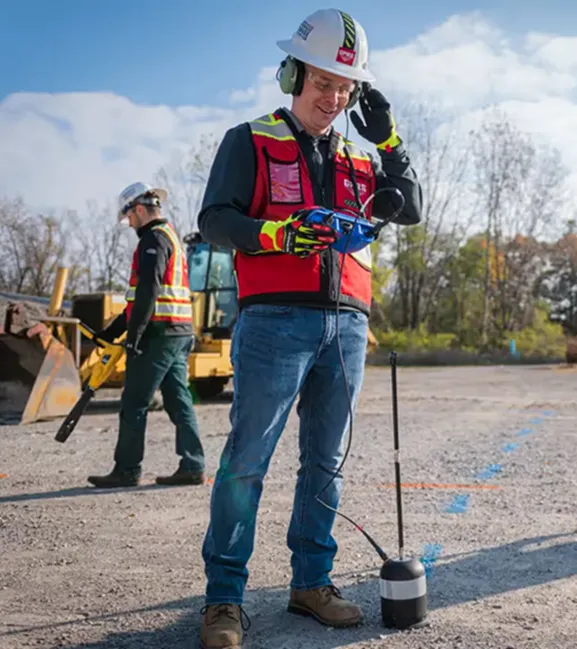
Acoustic leak detectors locate leaks with a sensitive ground microphone or an acoustic listening device. GPRS Leak Detection Project Managers use headphones to listen for and isolate the leak tone. When used at the surface level, a bell-shaped acoustic shield referred to as an “elephant’s foot” can be added to the ground microphone to help isolate the sounds coming from the pipes.
After listening to the pipes in the staircase, Walhovd couldn’t hear anything that resembled a leak. So, he changed gears by applying gas tracing methods.
“When I didn't hear anything in the pipes along the stairs, we drained the system and applied a non-flammable, non-toxic gas mixture to essentially turn it into a gas leak,” Walhovd explained. “While listening in that area, we could hear the gas escaping.”
When asked what the difference was between the sound of a leaking pressurized water pipe with and without gas tracing, Walhovd explained the following:
“It's very different. If you can hear like the water running in your house if somebody uses the shower. That's what water leaks sound like. And [gas tracing a water leak] sounds like somebody blowing bubbles underwater. You'd hear water and gas escaping at the same time, but it's a totally different sound.”
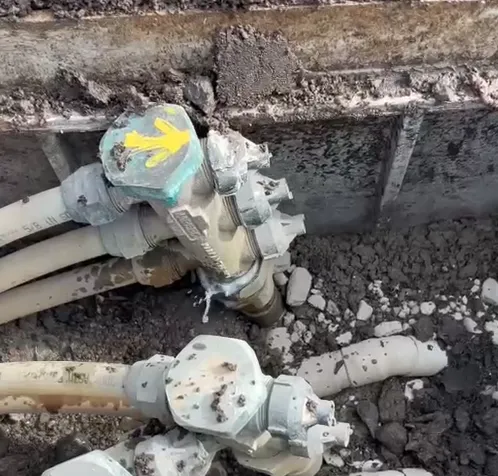
Upon further investigation, Walhovd found the source of the leak.
“We discovered that there was a box that was buried and the lid of the box was crushed,” Walhovd explained. “As soon as we opened it up, we could see that the manifold inside was up against the vault lid that was crushed and that was leaking. The vault lid was in rough shape and the client suspected that recent crane usage in the area was to blame for the leak.”
The client fixed the leak on the spot by using a pair of pliers to tighten the vault lid and hasn’t had any problems since.
From skyscrapers to sewer lines, GPRS Visualizes the Built World to keep your projects on time, on budget, and safe.
What can we help you visualize?
FREQUENTLY ASKED QUESTIONS
What is an annual leak survey and why do they matter?
An annual leak survey is a scheduled inspection of water infrastructure to identify and document leaks. These surveys are critical for regulatory compliance, environmental protection, and cost control. Regular assessments reduce water loss, prevent hazardous conditions, and extend asset life. For municipalities and facilities, annual surveys support proactive maintenance and budget forecasting.
How long does a leak detection usually take?
How long it takes to find your leak depends on the system size, complexity, and access conditions. A standard survey of a small facility or municipal segment may take several hours, while larger networks can require multiple days. GPRS optimizes efficiency through pre-survey planning and site walks, real-time data collection, and advanced equipment, minimizing disruption and ensuring timely reporting.
Can GPRS determine the size of a detected leak?
GPRS determines the size of the leak by how far the leak signal travels between contact points and the pitch of the tone received. GPRS does not, however, produce formal leak estimations.
What is SIM?
Subsurface Investigation Methodology (SIM) is a standard operating procedure and set of professional specifications that work as a guide for utility locating experts when scanning for buried utility lines. All GPRS Project Managers are required to achieve SIM 101 certification, which requires 80 hours of hands-on training in a classroom setting and 320 hours of mentorship in the field. For reference, the American Society for Nondestructive Testing’s (ASNT) minimum training recommendation includes eight hours for training and 60 hours practicing GPR to achieve NDT Level 1 certification in ground penetrating radar (GPR) scanning.
SIM requires the use of multiple, complementary technologies, like GPR scanning and electromagnetic (EM) locating, when locating buried utilities or scanning a concrete slab.