
.svg)

.svg)

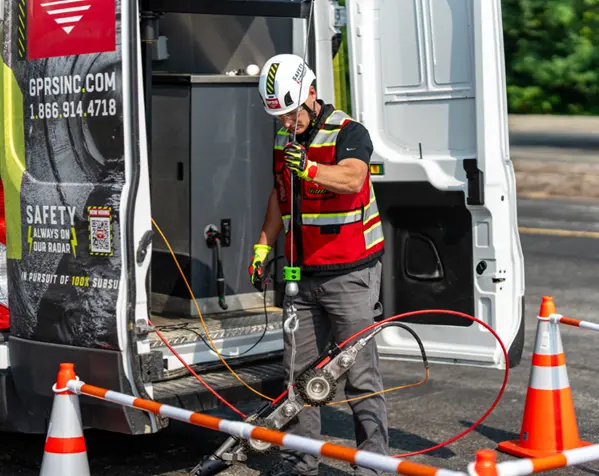
Sewer systems are the unsung heroes of utility infrastructure management. When they are operating properly, the public doesn’t even think about them. The moment those forgotten sewer lines fail, however, everyone pays attention, putting a harsh spotlight on waste and stormwater managers whose only goal is to keep things running smoothly.
So, any tools available to wastewater asset managers to keep sanitary and storm sewer lines intact and at maximum efficiency are valuable. The most valuable tool in that arsenal is CCTV pipe inspection, also known as a sewer scope. GPRS calls it Video Pipe Inspection.
But not all sewer scope companies and services are created equal, which is why utilizing NASSCO-certified providers is important. NASSCO’s standardization of education, training, and sewer condition assessment provide essential quality control and assurance for utility infrastructure managers nationwide. In recent years numerous municipalities have adopted ordinances requiring pre and post-direction drilling assessments to safeguard against cross bores, which most often occur in storm and sanitary lines.
What is NASSCO?
NASSCO stands for the National Association of Sewer Service Companies, a trade association of sewer professionals that “continues to lead the charge in providing quality education for pipeline condition assessment and inspection.”
The organization was created in 1976 with a goal of providing unbiased technical resources, technical guidelines, and other resources for sanitary and storm sewer professionals. Its guiding principles are described in its Mission, Vision, and Core Values statements.
• MISSION: To set industry standards for the assessment, maintenance, and rehabilitation of underground infrastructure, and to assure the continued acceptance and growth of trenchless technologies.
• VISION: To increase the awareness of aging underground infrastructure and to provide viable solutions through education, technical resources, and industry advocacy.
• CORE VALUES:
Adaptability | Camaraderie | Efficiency | Fairness | Knowledge | Support
The organization also provides important resource, technology and safety updates on a wide variety of topics:
- Confined Space Entry
- Fall Protection
- Hydration
- Hydrogen Sulfide
- PFAS
- Styrene Safety
- Trench Safety
- Pipeline Assessment, Maintenance & Rehabilitation
- Pipe Rehabilitation
- Manhole Rehabilitation
- Grouting
- Emerging Technologies
And offers the following courses:
- BSDI™- Building Sewer & Drain
- Grouting Safe Practices
- ITCP™ - Inspection Training Certification
- PACP™ - Pipeline Assessment Certification
- LACP™ - Lateral Assessment Certification
- MACP™ - Manhole Assessment Certification
- PACP™ for Asset Management
- Safe Use of Styrene
How NASSCO Set the Standard for Sewer Conditions
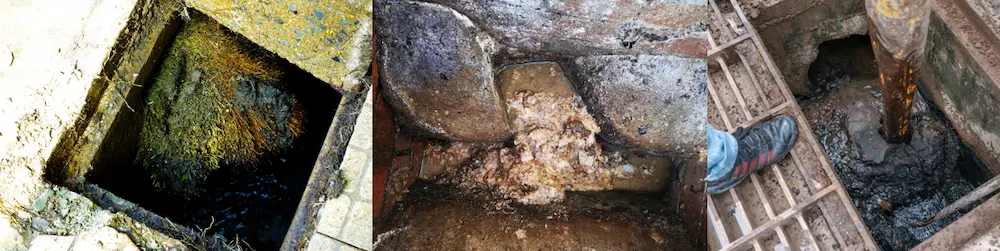
For nearly 50 years NASSCO has championed the assessment, cataloguing, and recording of sanitary and storm infrastructure to ensure its efficient management.
Aging pipes, incomplete or outdated as builts, wet weather surges, flooding, and an increasingly dense underground utility matrix can all elevate risk and expenses for wastewater managers. The consistency of certified NASSCO reporting gives managers and contractors a common language and categorization of data to evaluate conditions, prioritize interventions, mitigate defects, and defend decisions. Because NASSCO’s programs standardize defect identification across mains, laterals, and manholes, which enables reliable asset management, risk scoring, and capital planning.
NASSCO also provides strict quality control standards for sewer inspection data collection and cataloguing. Its QC guidance details procedures for verifying headers, flow direction, observations, defects, and pipe condition coding, so stakeholders, managers, or utility owners can audit sewer inspection contractors and maintain defensible datasets for repair prioritization and rehabilitation decisions. And the organization requires regular professional recertification, which helps keep sewer inspectors current with program versions and code updates.
A Note on Local Codes and Ordinances
Regulations and laws may vary state to state, and by community. And an increasing number of municipalities are passing mandatory pre and post-cross bore inspection requirements whenever utilities are installed via directional drilling. So, when hiring a sewer inspection professional, it is important to verify that their inspectors operate locally and are aware of the requirements for your specific location.
GPRS NASSCO-Certified Video Pipe Inspection Project Managers live and work in every major U.S. market. So you can be assured that your sewer inspection professional is up to date on your local laws and requirements, while backed with the power of both NASSCO & Subsurface Investigation Methodology (SIM) certifications, to provide the most accurate and complete storm and sanitary sewer assessments available.
Defining & Explaining NASSCO’s Three Core Certifications: PACP, LACP, and MACP
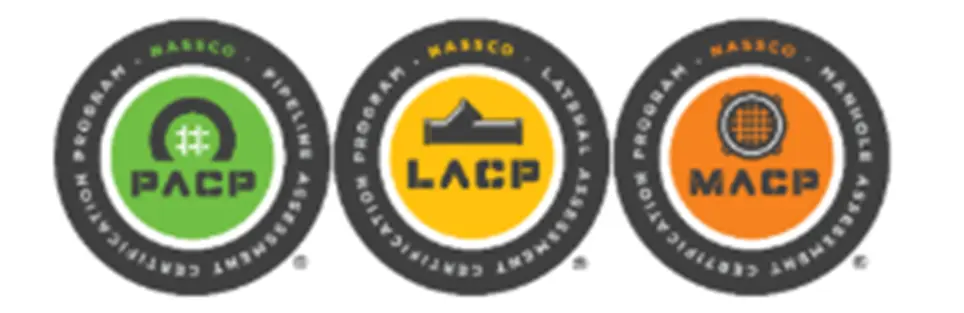
The three core certifications: Pipeline Assessment, Lateral Assessment, and Manhole Assessment, require multiple days of classroom instruction, followed by testing “to ensure assessment data is collected and coded in a consistent and reliable manner,” including the variances in lateral pipe material, size, and configuration, and the details of the components of manholes. An exam score of at least 85% is required for each certification.

PACP
The Pipeline Assessment Certification Program is the North American standard for gravity sewer defect identification and assessment. It uses standardized codes to classify pipe conditions:
- Structural
- Operation & Maintenance
- Construction
- Miscellaneous
These sewer data collection and classification standards enable utility owners, managers, and facility operators to build comprehensive databases, plan rehabilitation, and manage assets based on objective condition data.

LACP
The Lateral Assessment Certification Program extends PACP methodology to building sewers and laterals. That extension applies to everything with the exception of the Tap Break-In Code (TB Codes). It adds access point and fitting codes and applies a 1 to 5 defect grading scale to evaluate structural, operations and maintenance, and construction conditions in laterals, which often drive inflow/infiltration and service disruptions.

MACP
The Manhole Assessment Certification Program covers manholes and access points. While many of the same protocols for pipes and laterals apply, MACP defines component level observations for covers, frames, chimneys, cones, walls, benches, channels, and pipe connections, with Level 1 and Level 2 inspection detail to support targeted rehabilitation.
NASSCO also requires a two-day recertification course every three years for sewer inspection professionals to maintain their certifications.
How NASSCO Defect Classification Works

NASSCO’s code framework groups observations so that inspectors are able to record what they see without subjective interpretation. The defect codes cover five families:
- Continuous Defects
- Structural Defects
- Operations and Maintenance
- Construction Features
- Miscellaneous Observations
These codes are designed to provide quick shorthand for both the inspector and the person receiving the reports. Some examples of how defects may be coded include CL for longitudinal cracks (C for crack, L for longitudinal), FM for multiple fractures, HSV describes holes with soil visible, and IS for intruding sealing material.
The way to read these codes is as follows:
FAMILY > Group > Descriptor > Modifier > Structural Grade (1-5)
This consistency provides utility operators, wastewater, facility, and municipal managers with concrete, defensible ratings, trend analysis, and project scoping.
As mentioned, structural condition grades range from 1 to 5. PACP condition grades are assigned as Structural, Operations and Maintenance, or Overall Software like WinCan or manual tables help to translate each code and its modifiers into a grade, then calculate segment ratings and quick ratings for structural integrity, severity of defect, and overall condition.
The ratings reflect both the severity and frequency of pipe defects, with indexes that help managers compare segments and set priorities. It is important to note that the grades only apply to the pipe segment inspected, per NASSCO, and do not “reflect asset management principles,” unless you are receiving a full sewer system report, like GPRS’ VPI full system reports.
The type of sewer line – storm or sanitary – can also impact the quick rating and overall grade because a hole in a sanitary pipe may post a greater risk than one in a storm line.
These metrics can be applied to risk models, such as Likelihood of Failure combined with Consequence of Failure, as described in Underground Infrastructure:
“Segment scores can also be used to develop consistent “Likelihood of Failure” (LoF) values, which can be used with “Consequence of Failure” (CoF) values to develop risk assessments within an overall asset management program.”
Many owners reference code summaries that condense PACP tables for field use. For example, code charts may list structural families and O&M families with typical modifiers and grade triggers, which supports consistent camera work and coding.
Here’s an excerpt from NASSCO’s Condition Grading System documents that explains how ratings are calculated:
"The pipe rating is an infinite number, and one might incorrectly assume that the higher the number, the worse the condition of the pipe. For example, 9 occurrences of a grade 5 defect would result in a Pipe Rating 45. Similarly, 45 occurrences of a grade 1 defect would also result in a Pipe Rating 45. Finally, the Pipe Rating Index reports the average severity grade observed in the pipe to one or two decimal places. Since it is reported on a scale of 1-5, asset owners prefer the Pipe Rating Index for reporting and mapping. Asset owners should beware of prioritizing works based on averages; consider a Pipe Rating Index 3, it takes only 6 grade 1 defects to “hide” the fact that there are 6 grade 5 defects within the pipe section."
I/I, RDII, and Contamination: Why Standardized Reporting Reduces Cost and Risk
Inflow and infiltration introduce extraneous water that erodes capacity and drives treatment and pumping costs. The Environmental Protection Agency’s guidance explains how managers can estimate I/I using influent flow versus sewered population and wet weather analyses, then determine if I/I is excessive and warrants corrective action.
Wet weather rainfall-derived infiltration and inflow (RDII) is a frequent cause of sanitary sewer overflows and basement backups.
WEF’s fact sheet outlines RDII modeling approaches and the need for sound estimation, flow monitoring, and defensible data to design effective I/I reduction programs. Information from a 2023 Civil & Environmental Engineering study published in Water Resources Management states that “Rainfall-derived infiltration and inflow is extraneous water in a sanitary sewer system that originates from surface runoff. Most RDII enters sanitary sewer systems through illegal connections or mechanical faults, especially in aged sewer systems.” [Emphasis added]
Many state regulation and utility playbooks detail multi phase approaches: basin level flow monitoring, SSES investigations, targeted rehabilitation, and follow up monitoring. Each phase depends on consistent CCTV data and code based defect classification to pinpoint sources and verify results.
However, the only assured process to locate illegal connections, aka, illicit tie-ins, mechanical faults, or pipe defects in aging sewer lines is through a thorough CCTV video pipe inspection process, often in conjunction with smoke testing and/or dye tracing to pinpoint the location of illicit connections and I/I.
Certified NASSCO reporting provides you with the objective defect and condition ratings you need to prioritize cleaning, point repairs, lining, or replacement. It also supports capital planning across mains, laterals, and manholes with structural v. O&M distinctions that direct work to the right teams.
Cross Bores: A Hidden High Risk to Utilities
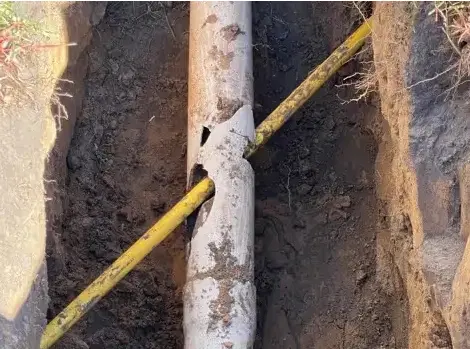
Cross bores occur when trenchless installation, aka directional drilling, intersects existing utilities, often sewer laterals. This most often occurs when telecommunications and fiber lines are installed using trenchless technology. Cross bores pose a grave threat, particularly with gas lines. Whether a telecom line intersects a gas line, or a gas line crosses into a sewer pipe, gas can create an explosion hazard. Federal and utility safety guidance documents the risk and recommends call before you clear protocols and proactive inspections to locate and mitigate cross bores.
Utility safety advisories emphasize pre and post directional drilling pipeline investigations and coordination with municipal utilities to prevent damage, injuries, and property loss. Certified lateral launch inspections and precise mapping reduce the probability of intersecting gas, sanitary sewer, or storm sewer lines.
How to Geolocate and Assess Your Sewer Pipes Digitally

SiteMap Sewer Layer Puts Your NASSCO-Certified Pipe Information at Your Fingertips
When you order a video pipe inspection from GPRS, your NASSCO-certified inspection results are delivered via the new SiteMap® Sewer Layer, where you can visualize all your sewer mains, laterals, and manholes, plan maintenance and rehabilitation, securely share information, and reduce potholing and utility strikes.
The cloud-based SiteMap sewer layer (patent pending) provides a single source of truth for wastewater and storm assets that includes RTK geolocation accuracy and maps, flow direction, depth, pipe material, full WinCan reports, and in app video for each pipe segment.
All your sewer pipeline defects are coded and categorized to NASSCO standards. SiteMap integrates WinCan Web so you can view videos, photos, and condition data inside the platform, export reports, and coordinate work from anywhere. The recent SiteMap upgrade formalized sewer visualization and cross bore flagging, helping managers see each geolocated pipe segment and its condition in one interface.
NASSCO Certified Video Pipe Inspection, Pre & Post Directional Drilling Assessments, Smoke Testing, Dye Tracing & More
GPRS deploys robotic crawlers and lateral launch systems to inspect mains, laterals, and manholes, coded to PACP, LACP, and MACP standards by NASSCO certified Project Managers. They also can conduct checks for I/I and illicit tie-ins with smoke tests and dye tracing, among other services. Project deliverables can be customized to your needs and include full sewer maps, geolocated defect photos and video, color-coded defect severity ranking, and interactive WinCan reports that adhere to NASSCO standards. Video pipe inspection supports the rapid diagnosis of leaks, deformations, intrusion, obstacles, infiltration, and cross bores, while minimizing destructive exploratory excavation. And their SiteMap® platform delivers it all at the touch of a button.
Targeted Benefits for Wastewater, Utility, and Facility Managers
- Avoid I/I and Contamination: PACP/LACP/MACP coding isolates infiltration sources and O&M issues for targeted cleaning, sealing, or lining, supported by basin level I/I programs. SiteMap’s data continuity helps verify reductions and defend budgets.
- Prevent Cross Bores: Lateral launch inspections identify gas line intersections. SiteMap’s mapping and video provide permanent documentation to guide safe maintenance.
- Reduce Cost and Downtime: Accurate defect localization and RTK grade mapping cut exploratory dig time, lower change orders, and reduce service interruptions.
- Strengthen Asset Management: Structural v. O&M ratings support risk scoring, prioritization, and capital planning. Standardized reports enable trend analysis and performance tracking post rehab.
Recommended Best Practices for Sanitary and Storm Sewer Assessment & Remediation
- Scope Priority Basins or Facilities: Start with wet weather problem areas, recurring backups, or high consequence corridors. Use flow data and complaints to select basins for VPI and SSES.
- Commission a NASSCO Certified Video Pipe Inspection: Engage GPRS to inspect mains, laterals, and manholes, and deliver PACP/LACP/MACP reports with mapped defects and video.
- Access Your Data in SiteMap’s Sewer Layer: Centralize and share RTK accurate maps and condition data, including cross bore findings, to coordinate maintenance and capital projects.
- Execute I/I Reduction: Analyze your inspection data to plan cleaning, sealing, point repairs, lining, or replacement, then verify with follow up monitoring and inspections to mitigate sewer line problems.
NASSCO’s PACP, LACP, and MACP provide a consistent framework to code defects and compute meaningful ratings that drive risk based decisions. Pairing that rigor with GPRS’ NASSCO certified inspections and the SiteMap Sewer Layer gives managers unprecedented sewer visibility, defensible analytics, and actionable maps to avoid I/I, contamination, cross bores, and costly surprises.
Click here to learn more, request a quote, or schedule service.


.avif)