3D Laser Scanning Services in Louisiana

As an architecture, engineering, or construction professional, you understand that projects require a tremendous amount of planning and coordination. GPRS 3D Laser Scanning can deliver accurate as-builts, point clouds, 2D CAD drawings, 3D photogrammetry, and 3D BIM models to expedite project planning and reduce change orders, delays, and costs.

Whether you are a general contractor or facility manager planning renovations or modifications, or an architect or engineer who requires precise project data, GPRS provides accurate existing conditions documentation, reality capture, and scan-to-BIM services to bring your design and construction projects in on time, and on budget.

When you need accurate architectural, structural, and MEP system dimensions, locations, and layouts for design, prefabrication, clash detection, facility modifications, or asset management, call GPRS. 3D laser scanning minimizes shutdowns and disruptions, eliminates the need for site revisits, and provides accurate as-built data to reduce risk and increase project efficiency.
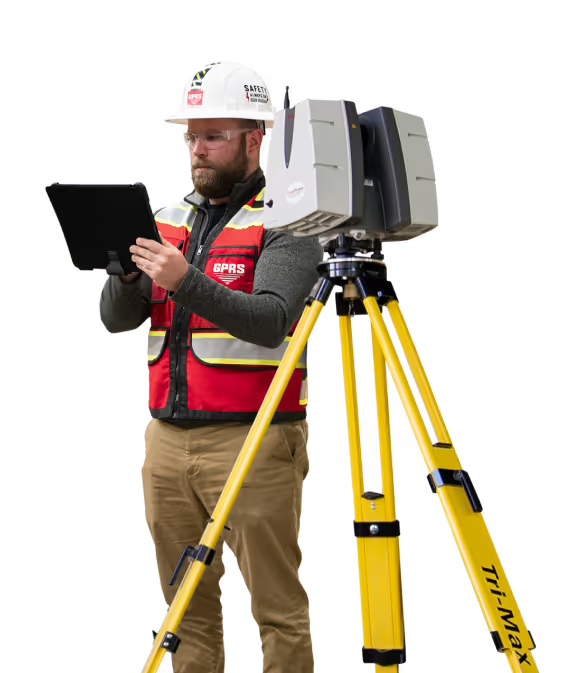
A man in a hard hat holding a tablet.

Request A Quote

I am the homeowner on a residential project
Format: 123-456-7890

Project Location

Project Information

To select multiple options, press CTRL

Project Notes *

File Attachments


New Orleans 3D Laser Scanning

504-312-1009laser@gprsinc.com

GPRS Project Managers

GPRS is the leading provider of 3D laser scanning services in Louisiana. Our Project Managers document your site with the Leica ScanStation P-Series and the Leica RTC360 3D laser scanners, capturing up to 2 million data points per second with 2-4 millimeters accuracy. Each Project Manager completes the most extensive training program in the industry, with 80 hours of hands-on classroom training and 320 hours of mentorship in the field, plus another 40 hours of LiDAR training to deliver expertise in 3D laser scanning equipment and field knowledge.

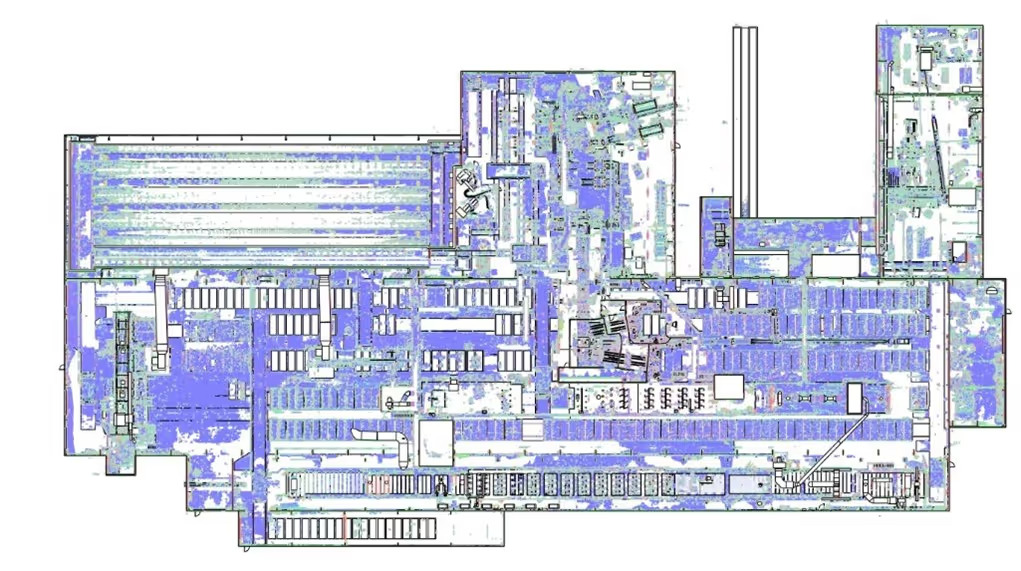
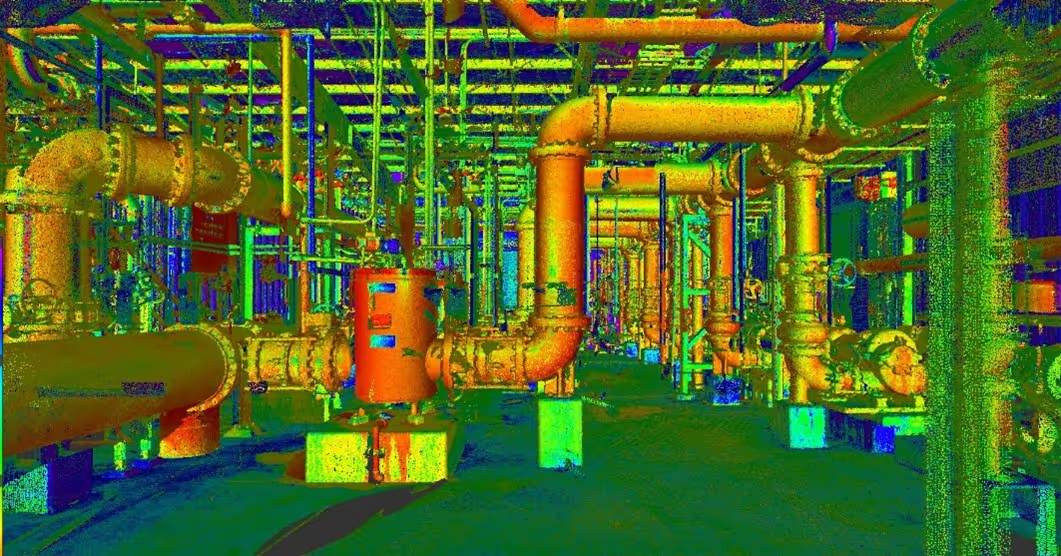
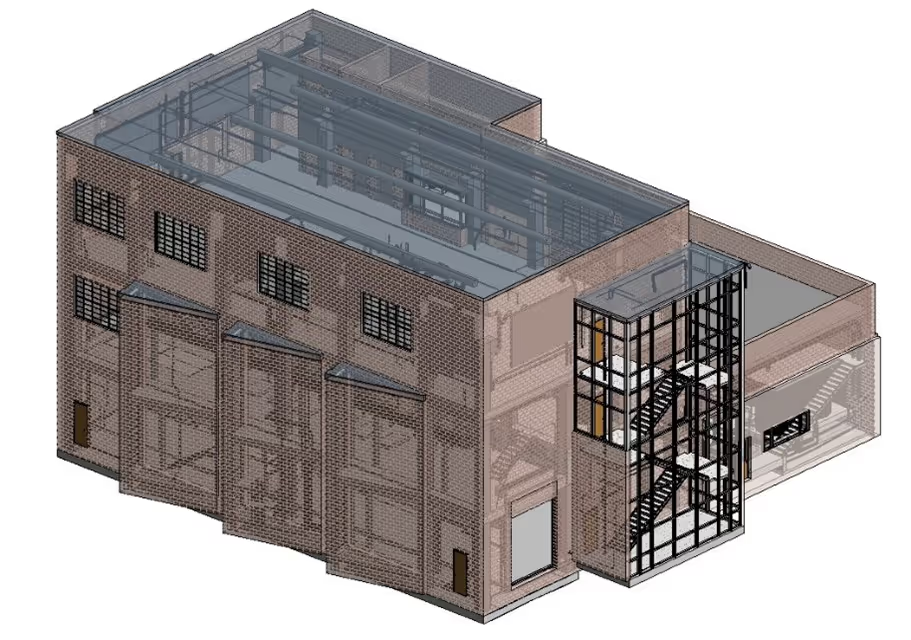
A 3D image of a factory with pipes and valves.A drawing of a road with a red line on it.A 3D drawing of a building with a staircase.

GPRS Mapping & Modeling Team

Construction drawings and models streamline planning, visualization, and coordination on your project because they provide a single source of truth for designers, architects, engineers, and contractors. GPRS’ in-house Mapping & Modeling Team can customize as-built data, 2D CAD drawings, 3D BIM models, 3D mesh models, virtual tours via WalkThru 3D, digital twins, floor plans via FLRPLN, and more to ensure you have all the information you need to get the job done right, delivered via GPRS’ SiteMap® digital storage software and app.

Maps and models can be produced at any level of detail in a variety of formats such as Revit, AutoCAD, ReCap, Navisworks, Civil 3D, BIM360, A360, Bentley, Leica Cyclone, Cintoo, and more. We have optimized workflows for importing data, registration, creating deliverables, quality checks, and transferring data to clients.

Not sure what you need? Not a problem. Our experienced Project Managers will work closely with you to define the project scope and use the right equipment and software to accurately map and model your project to accomplish your goals.

WHY CHOOSE US? 

THE GPRS DIFFERENCE.

With GPRS, clients can rest assured that our rigorously trained Project Managers use state-of-the-art technology to deliver the accurate as built information you need to do the job right. GPRS leads the industry to deliver precise as built information to enhance communication and collaboration among your project teams.

GPRS 3D Laser Scanning Services can bring these benefits to your project:

  • Collect up to two million data points per second with the highest-quality survey-grade laser scanners
  • Capture exact dimensions and measurements of your project site
  • Expedite planning and design with accurate as-builts
  • Eliminate site disruption and revisits
  • Receive precise point clouds, 2D drawings, and 3D models to improve collaboration and coordination
  • Tour the location, add digital notes, and even measure with a virtual tour
  • Reduce project risks, change orders, delays, accidents, and costs
GPRS main Logo: Intelligently Visualizing the built world | GPRS

GPRS 3D Laser Scanning Services in Louisiana

A blue and white drawing of a building with a lot of wires.
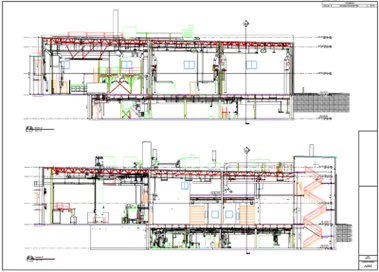
As-Built Services
As-built services capture exact architectural, structural, and MEP system dimensions and layout of existing buildings, facilities, and sites, making them invaluable for design, construction, renovations, and modifications.
Learn More
A green and blue image of a factory with pipes and valves.
Point Clouds
3D laser scanners record highly accurate digital measurements of sites and assets in the form of a point cloud and can be used to create 2D CAD drawings and 3D BIM models that improve project workflows, shorten turnaround times, and reduce costs.
Learn More
A 3D model of a building with a staircase.
3D BIM Modeling
Intelligent 3D Building Information Models (BIM) provide contractors, engineers, architects, and facility managers an accurate digital twin of buildings and infrastructure to collaborate on design, construction, and operations.
Learn More
A picture of a building with a red circle in the middle.
3D Photogrammetry
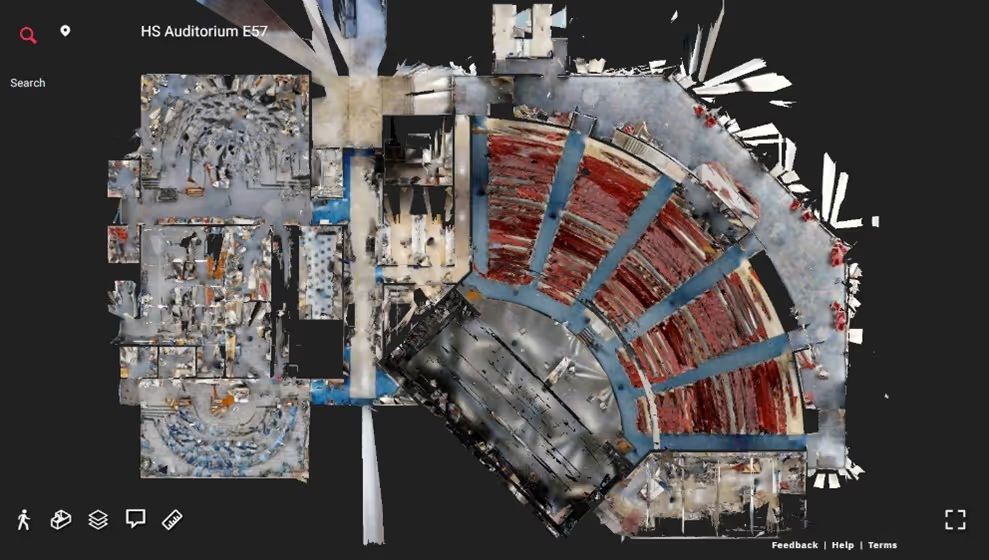
3D rendered images can be used to create virtual tours, floorplans, topographic maps, point clouds, 3D models, and more for planning, analysis, and calculations.
Learn More
A drawing of a building with a red roof and a green roof.
2D CAD Drawings
GPRS can translate 3D laser scan data into 2D CAD drawings that provide your team with up-to-date floor plans, elevations, sections, details, isometric drawings, reflected ceiling plans, and more.
Learn More
A red pipe with a blue wire running through it.
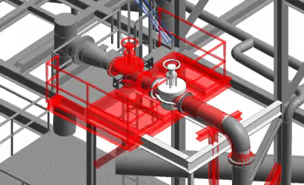
Clash Detection
3D laser scanning captures as-built site conditions with 2-4 mm accuracy, helping to identify potential clashes, prefabricate components, and plan a flawless installation.
Learn More
A 3D drawing of a church with a steeple.
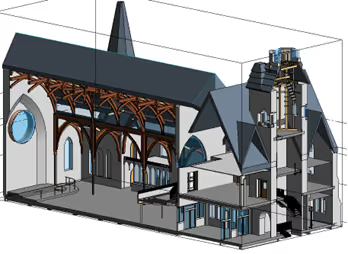
Design-Build
3D laser scanning provides accurate as-built site data to prevent expensive rework by identifying any mistakes early in the design through the construction phase.
Learn More
A stadium seating chart with a red line on the field.
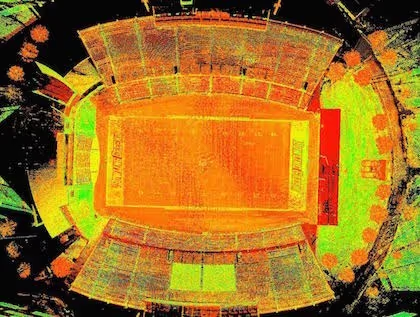
Drone Imagery
GPRS offers rectified photogrammetry, aerial video and images, LiDAR scans, 2D orthomosaic images, CAD drawings, 3D models, and 3D fly throughs thanks to a wide-range of drone services operated by FAA Licensed pilots.
Learn More

We provide 3D Laser Scanning Services to these Louisiana counties & many more:

  • East Baton Rouge Parish
  • Jefferson Parish
  • Orleans Parish
  • St. Tammany Parish
  • Lafayette Parish
  • Caddo Parish
  • Calcasieu Parish
  • Ouachita Parish
  • Livingston Parish
  • Tangipahoa Parish

Our portfolio of work includes projects in these Louisiana cities & many more:

  • New Orleans, LA
  • Baton Rouge, LA
  • Shreveport, LA
  • Metairie, LA
  • Lafayette, LA
  • Lake Charles, LA
  • Bossier City, LA
  • Kenner, LA
  • Monroe, LA
  • Alexandria, LA

Utility Locating & Laser Scanning Aid Design Renovations for Florida State University

A comprehensive site scan, delivering utility maps and a 3D BIM model allowed the architect to plan precise renovations to the stadium’s layout, from design changes and material selection, to cost estimation and construction phasing, with ease.
GPRS provided above and below-ground as-built data to Florida State University’s Doak Campbell Stadium, including subsurface utility maps, and an architectural/structural 3D BIM model that the client could access via our SiteMap GIS Platform. A $255-million-dollar renovation project required accurate data to update the stadium seating with founder’s boxes and a field level club.
GPRS provided above and below-ground as-built data to Florida State University for a $255-million-dollar renovation project to update Doak Campbell Stadium, including subsurface utility maps, plus an architectural and structural 3D BIM model that the customer could access via our SiteMap GIS Platform.
BIM Model Aids Design Renovations for Stadium A BIM model provided the stadium owners a better understanding of the design updates. Tallahassee, Florida Task: An architect requested an ArchiCAD BIM model of a college football stadium to create renovation construction documents. Problem: A vast amount of space required as-built documentation, over 600,000 sq. ft. needed 3D laser scanned and modeled. The renovation changes were complex. A BIM model was needed to provide the stadium owners a better understanding of the architecture and design updates. Our client needed a single source of data, where all architects on the team could see the latest design and document their changes. Solution: The exterior and interior of the stadium were 3D laser scanned with 2-4 millimeter precision, including three concourse levels, stadium seating, and suites. TruePoint delivered an intensity map point cloud, TruView viewer files, and a Revit 2021 3D model of the stadium. Working from precise details in the 3D model, renovations can be designed right the first time, saving time and costly change orders. Benefits: The architect utilizes the Building Information Modeling (BIM) process to provide their clients a better understanding of the complexities of architecture and design. Technical construction drawings (floor plan views, elevation views, cross-sections, iso-metric representations, etc.) can be effortlessly created from the 3D BIM model and shared with all disciplines. A BIM model allows architects to plan precise renovations, from design changes and material selection, to cost estimation and construction phasing.
All
3D Laser Scanning
3D Laser Scanning
As-Built Creation
Mapping & Modeling

Accurate PT Cable Layout Critical to Construction

GPRS’ detailed 2D CAD drawings and 3D BIM model allow for safe cutting, coring & drilling for building-wide MEP and HVAC installations.
GPRS located and marked the full post-tension cable system layout for 12 floors of a 49-floor building, with approximately 12,500 sq. ft. of concrete on each floor. After concrete scanning was completed with ground penetrating radar technology, GPRS 3D laser scanned each floor to produce 2D CAD drawings and a 3D BIM model for virtual design and construction. The architect received a permanent record of the post-tension cable layout to complete fit and finish design plans for the building.
Mapping the PT cable layout in concrete slabs facilitates design and minimizes the risk of injuries and delays.
GPRS’ detailed 2D CAD drawings and 3D BIM model allow for safe cutting, coring & drilling for building-wide MEP and HVAC installations. Construction Concrete Scanning, 3D Laser Scanning & 3D BIM Modeling Concrete scanning services will locate critical targets like post tension cables, rebar, conduits, voids, and more to help keep your project on time, on budget, and safe. 3D laser scanning captures concrete markings with 2-4mm accuracy for GPRS to transform into custom 2D CAD drawings and 3D BIM models. GPRS located and marked the full post-tension cable system layout for 12 floors of a 49-floor building, with approximately 12,500 sq. ft. of concrete on each floor. After concrete scanning was completed with ground penetrating radar technology, GPRS 3D laser scanned each floor to produce 2D CAD drawings and a 3D BIM model for virtual design and construction. The architect received a permanent record of the post-tension cable layout to complete fit and finish design plans for the building. Post-tension cable location, spacing, and depth are determined by an engineer, are specific to each project, and must be traced in short distances to reveal the slope. Each tendon pulls 24,000 to 33,000 lbs. of pressure. Damaging a cable when cutting, coring, or drilling into a slab can cause a tendon to burst with enough force to cause severe injury or death, and impact the structural integrity of the slab. Replacing a single post-tension cable costs $10,000 - $20,000. Experienced Project Managers used ground penetrating radar (GPR) technology to locate and mark the precise details of each concrete reinforcement, documenting the location, number of cables, and depth directly on the slab and ceiling. After the post-tension layout was complete, each floor was 3D laser scanned to capture the field markings. That data was used to create a virtual tour, 2D CAD drawings (PT site layout and floor contours,) and a complete 3D BIM model of the site. The captured point cloud data was aligned to survey control, then to the client’s design model, further ensuring the accuracy of the data. GPRS has a verified 99.8% accuracy rate for concrete scanning, backed by our Green Box Guarantee. Laser scanning is accurate within 2-4mm. An accurate layout of post-tension cables protects tendons from damage, prevents injury and mistakes, and protects the integrity of the building. 2D plan sheets and a 2D floor contour map documenting the actual floor elevation added even more accuracy to the depth of cover that is field marked. The 3D BIM model provided the architect data to plan fit and finish designs and coordinate with contractors and MEP trades before build-out.
All
3D Laser Scanning
3D Laser Scanning
Mapping & Modeling
Concrete Scanning

3D Laser Scanning and BIM Modeling for Pittock Block Data Center

GPRS used 3D laser scanning and BIM modeling to support Whiting-Turner’s renovation of one of the most critical telecom hubs on the West Coast.
GPRS partnered with Whiting-Turner to 3D laser scan 200,000 square feet of the Pittock Block Internet Exchange in Portland, Oregon, an eight story, 302,262 square foot carrier hotel, data center, and office space. Built in 1914, the historic building was adaptively reused from an electric substation into a modern data center that now hosts one of the highest densities of telecom networks and carriers on the West Coast. Whiting-Turner planned renovations to tenant and common areas on the ground, mezzanine, fourth, and eighth floors, including new entry vestibules, infrastructure upgrades, support rooms, and façade modifications. To support this work, GPRS captured as-built data of the building to generate a point cloud, CAD drawings, and Autodesk Revit Model.
GPRS partnered with Whiting-Turner to 3D laser scan 200,000 square feet of Pittock Block Internet Exchange in Portland, Oregon, an eight‑story, 302,262 s.f. carrier hotel, data center, and office space. Built in 1914, this historic building underwent adaptive reuse, evolving from an electric substation distribution location into a modern data center that now houses the second greatest density of telecom networks and carriers on the West Coast. Whiting-Turner was planning a renovation of tenant and common areas on the ground floor, mezzanine level, fourth floor, and eighth floor, including the construction of new entry vestibules, infrastructure and equipment upgrades, and support rooms as well as modifications to ground-floor facades. To support the renovation, GPRS reality captured as-built data of the building to generate a point cloud, CAD drawings, and an Autodesk Revit Model.
Highlights THE BOTTOM LINE GPRS used 3D laser scanning and BIM modeling to support Whiting-Turner’s renovation of one of the most critical telecom hubs on the West Coast. INDUSTRY Data Center SERVICE 3D Laser Scanning, Mapping & Modeling LOCATION Portland, Oregon GPRS Insight "This property spanned an entire city block and featured a central lightwell. My 3D scanning training and experience helped me to accurately tie in data from the lightwell to the rest of the building. The roof also contained an extensive cooling system to ensure that hot air generated by the data center is expelled to prevent damage to the servers." Daniel Jones, GPRS Project Manager Deliverables Point Cloud, 2D CAD Drawings, Autodesk Revit 3D BIM Model PROJECT APPLICATION GPRS delivers precise as‑built documentation to support data center construction, retrofits, and facility management. Through 3D laser scanning, CAD, and BIM modeling, we provide accurate data that empowers owners, contractors, and design teams to confidently design, build, operate, and maintain their facilities. Task GPRS partnered with Whiting-Turner to 3D laser scan 200,000 square feet of the Pittock Block Internet Exchange in Portland, Oregon, an eight story, 302,262 square foot carrier hotel, data center, and office space. Built in 1914, the historic building was adaptively reused from an electric substation into a modern data center that now hosts one of the highest densities of telecom networks and carriers on the West Coast. Whiting-Turner planned renovations to tenant and common areas on the ground, mezzanine, fourth, and eighth floors, including new entry vestibules, infrastructure upgrades, support rooms, and façade modifications. To support this work, GPRS captured as-built data of the building to generate a point cloud, CAD drawings, and Autodesk Revit Model. PROBLEM Renovations and infrastructure upgrades needed to be completed without disrupting ongoing tenant operations or critical systems. The facility could not experience downtime, as it housed 16 fiber optic carriers, 179 service providers, and seven subsea cables critical to its role as a global grade Internet Exchange. Renovations across multiple levels, including the ground, mezzanine, fourth, and eighth floors, had to modernize shared spaces, infrastructure, and systems while maintaining uptime. Entry vestibules needed to be updated in a way that enhanced security, yet preserved smooth tenant and visitor flow. Specialized rooms had to be designed and constructed to support IT infrastructure and facility operations while meeting strict technical requirements. Ground floor facades required modification while preserving the building’s historic character. Infrastructure and systems essential to data center operations had to be upgraded to ensure reliability, scalability, and compliance with industry standards. Scheduling challenges had to be addressed when certain areas were unavailable for scanning or construction due to demolition or phased work. ‍ Solution GPRS’ Project Manager captured 200,000 square feet of space with the Leica RTC360 scanner at 2-4mm accuracy, completing 504 individual laser scans. Two mobilizations were conducted to ensure complete coverage of the basement, levels 1–4, level 8, and the roof. All architectural, structural, and MEP systems, including data closets and cooling systems, were documented in a colorized point cloud, capturing walls, floors, ceilings, doors, windows, roof infrastructure, exposed columns, beams, stairs, piping, conduit, and ducts. An Autodesk Revit 3D BIM model was generated to provide precise details of the data center’s spatial relationships, geometry, structure, and systems. From the BIM model, 2D CAD drawings were produced to support pre-construction planning, enabling teams to quickly understand the project scope before advancing into detailed 3D modeling. ‍ Benefits 3D laser scanning delivered a comprehensive, real time digital view of the data center, capturing precise structural and MEP layouts that seamlessly integrated with CAD and BIM for accurate planning, clash detection, and efficient construction sequencing. Deliverables were shared via SiteMap, GPRS’ secure, cloud based platform and mobile app, which centralized point cloud data, CAD files, and BIM models into an interactive tool for easy access and collaboration. With accurate facility as-builts, errors, change orders, delays, and costs were reduced during renovation. Cooling system upgrades were enhanced through precise modeling of roof infrastructure. Whiting-Turner successfully delivered turnkey data center renovations to meet tenant needs.
All
As-Built Creation
Mapping & Modeling
3D Laser Scanning

GPRS
INTELLIGENTLY VISUALIZING THE BUILT WORLD®