
.svg)

.svg)

GPRS Project Managers spent three months scanning concrete to provide clearances at more than 600 sites over 17 floors to guarantee the renovation of an apartment complex proceeded safely and on schedule.
Morley Builders began an extensive renovation of a nearly 60-year-old building that once served as a nursing home. The structure didn’t have air conditioning, had mold damage, and still contained asbestos, so they needed to perform a full remodel.
One aspect of the project involved over 1,000 concrete cores so they could run new electrical and communication lines throughout the complex. That was where GPRS came in.
GPRS had not previously worked with Morley Builders, so Project Manager Adrian Orozco started with a few scans to show them our process and results.
“They saw that I was able to help them out, so there was some trust being built,” Orozco explained. “Being able to supply what they need and being able to communicate with their superintendent, we were able to come to an agreement on how long they needed me to be there.”

Orozco was then tasked with scanning concrete on every level of the 17-story building. By using ground penetrating radar (GPR), Orozco provided clearances at each requested area to ensure they could safely cut into the concrete.
He marked his findings on the concrete’s surface with red, blue, and green markers. When Orozco was confident he’d located an area free of obstruction, he marked the area with GPRS’ trademark green box and check mark, showing it would be safe to cut or core within that green box. This is known as GPRS’ Green Box Guarantee®. When a Project Manager marks a slab with a green box, we are so confident in our scan data that, if we’re wrong, we will pay for the material costs of the damage.
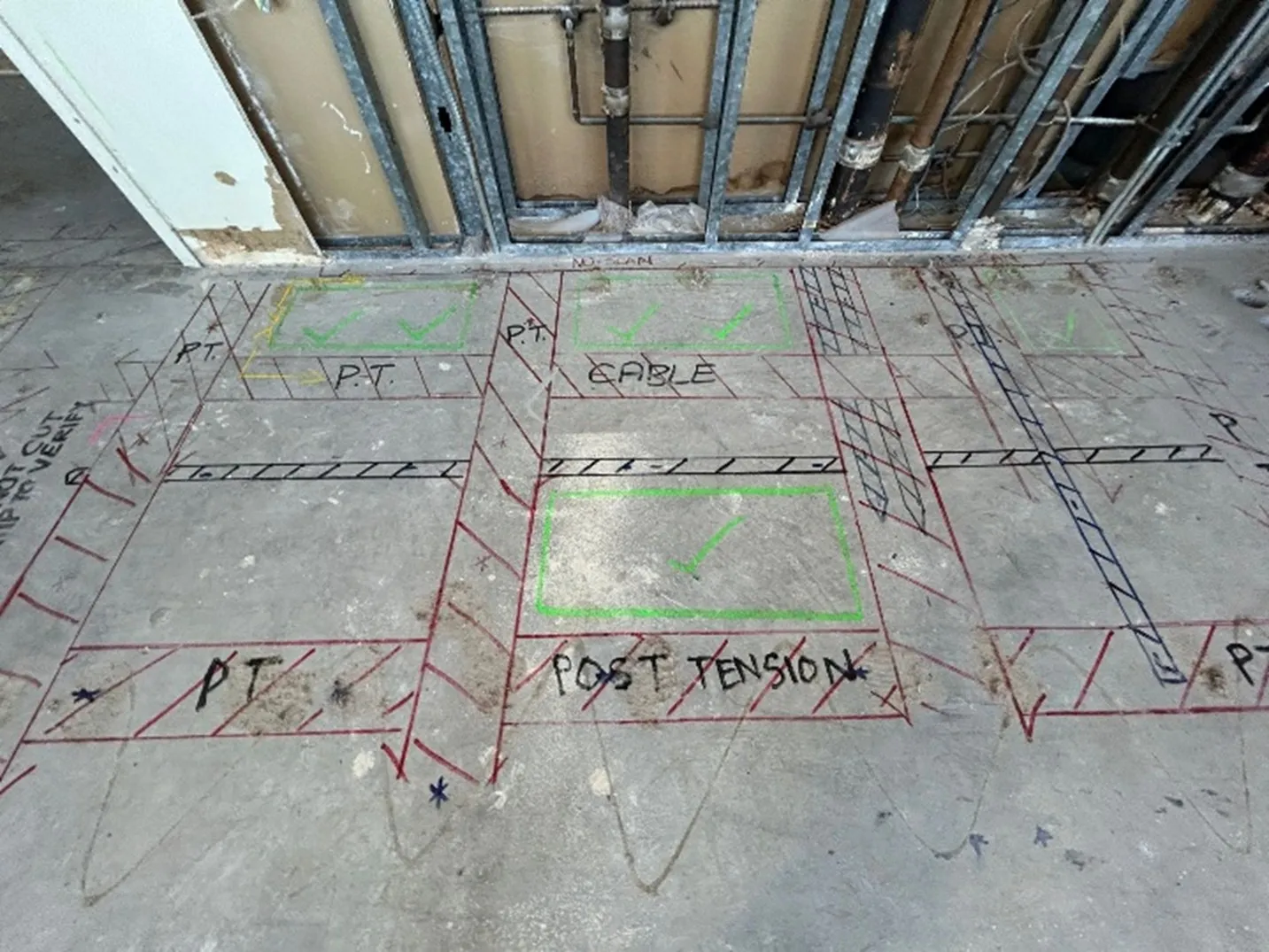
Within the first week, Orozco’s results showed that some of the areas they planned on coring were too congested with post tension cables for them to drill into.
If the client hadn’t had GPRS-verified data marked out in front of them, they would have cored into those areas, struck PT cables, and the project would have faced larger issues than a few months of delays.
A single severed post-tension cable can cost upwards of $30,000 to repair or replace, and it can also lead to structural failure that endangers the lives of not only those completing the work but anyone in the immediate area.
For most of the three-month job, Orozco was a one-man show, but he did call in help from fellow Project Manager Joseph Hertada, Area Manager Ryan Hanahan, and two PM trainees for a few days.
Orozco developed a massive collection of photos from the job over the course of the job.
“I have over 600 images in my gallery for just that job because I like to keep an album for big jobs like this,” Orozco explained.
Even though GPRS Project Managers have maintained a 99.8% accuracy rate on concrete scans with GPR, there are some limitations of GPR that must be considered. Some factors that could affect GPR when scanning concrete include electromagnetic interference from nearby electronic devices, the depth & size of the target, and moisture content since GPR is often more successful in dry conditions.
After GPRS cleared more than 600 locations and Morley successfully performed over 1,000 cores, Orozco noted only two incidents. Despite the hiccup in production these moments caused, the outcomes ultimately served the project in the long run.
“We were limited to how much we could scan, because of a stud rail that they had placed,” Orozco explained. “Unfortunately, perfectly aligned below the stud row, there was a J-box where the conduit was running right beneath the slab. So, they had asked why we weren't able to locate it and I explained to them the limitations of GPR. Because of this, they cut out every single stud row for every wall they were going to cut out to avoid that.”
The one other issue occurred when a subcontractor dug in an area Orozco’s team had marked unsafe.
“The subcontractor saw the area they needed to core and dug even though I marked the area in red,” Orozco explained. “It turned off all the lights in the whole room. The client was understandably upset as they had thought something was mismarked, but they got up there and saw for themselves what was laid out already.”
Both of these unusual incidents allowed the client to address an anomaly in their planning and make sure their subcontractors know to trust the markings presented by GPRS.
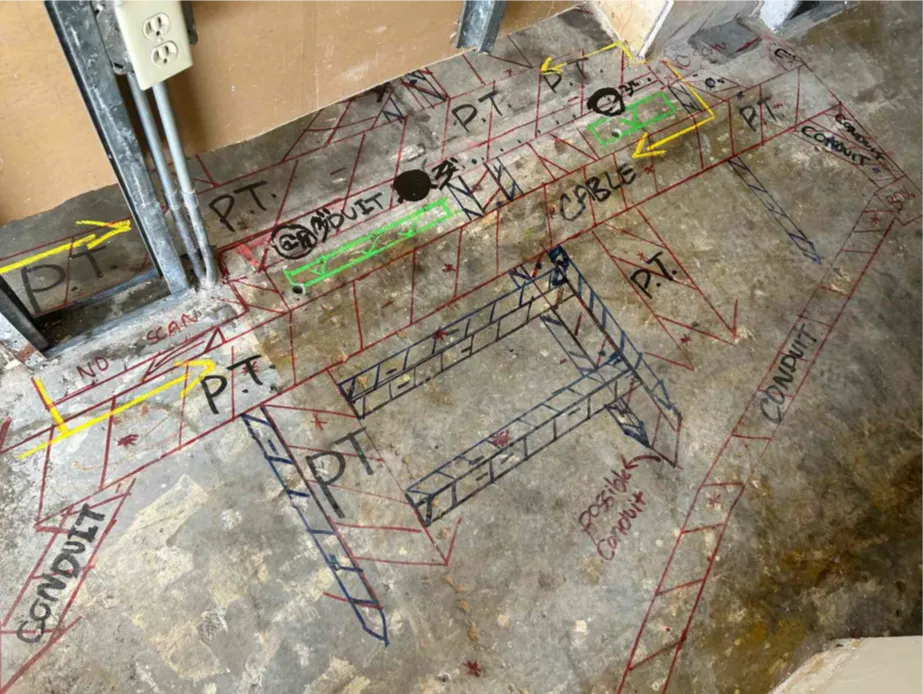
After all his time with GPRS, Orozco couldn’t help but marvel at the scale of work he had completed.
“I’ve been with the company for two years and this is the biggest job I’ve done,” Orozco explained. “This was a three-month job and each floor was around 250 square feet. We’re looking at over 4,000 square feet of space scanned, at least.”
Upon the completion of the job, Morley was so thrilled with the results that they have already requested to work with GPRS again on more projects.
“We were able to get them up to date on their quota and they want to continue working with us,” Orozco explained. “They have a second project, another apartment renovation, and they want us to solely be their scanners on site for that job.”
From apartments to arenas, GPRS Visualizes Your Built World®—above, below, and beyond—to keep your projects on time, on budget, and safe.
What can we help you visualize?
FREQUENTLY ASKED QUESTIONS
How does GPRS contribute to jobsite safety in construction?
GPRS’ #1 focus is safety and part of our mission is the pursuit of 100% subsurface damage prevention because sending your team home safe and sound every day is the most important job we can help you do.
Our Subsurface Investigation Methodology (SIM) provides the gold standard in underground utility locating and concrete scanning, so we can help you ensure your team is clear to cut, core, or drill with confidence. Our Video Pipe Inspection services provide NASSCO-compliant PACP-coded defect and condition reporting, pipe locations, and more. And, our reality capture services provide 2-4 millimeter-accurate structural measurements to help you avoid clashes, reworks, and downtime. Because when you know what’s hidden/underneath, you can build more safely.
Can GPR scan concrete slab-on-grade?
Yes, it can. Unlike with X-ray, where both sides of a concrete slab must be accessible to obtain a picture of the subsurface structure, GPR only requires access to one side of a slab to obtain a comprehensive view of what’s inside the slab. This makes it an ideal technology for evaluating concrete slab-on-grade.
Can GPRS scan vertical surfaces or ceilings?
Yes, GPR can scan for the location of rebar in concrete columns and walls. It can also scan the underside of a floor to mark out the reinforced steel and any embedded conduits.


