
.svg)

.svg)

This is the second in our multi-part series on the findings, recommendations, and potential impacts of the Common Ground Alliance’s 2024 DIRT Report. You can find Part 1, here.
“The Path Forward Requires Systemic Change” says a headline on page 5 of the Common Ground Alliance’s 2024 DIRT Report.
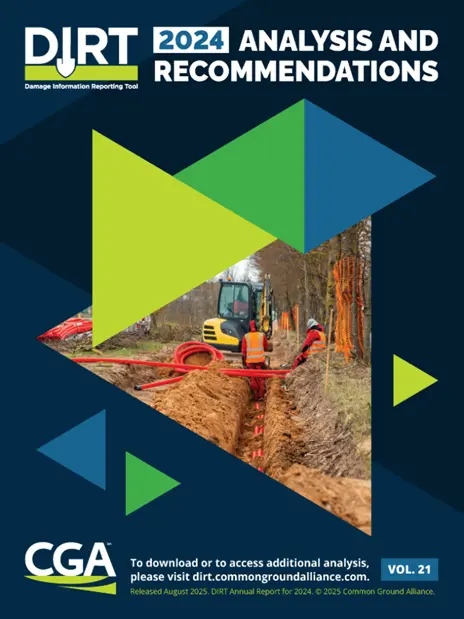
Citing a continued increase in damages caused by excavation and construction-related utility strikes, and the peer-reviewed results of 58 excavation companies as part of the their Damage Prevention Institute (DPI), the CGA has developed five “Recommendations for Breaking Through the Damage Prevention Plateau.”
These five recommendations point to a broad-spectrum approach to reducing utility damages: focusing on everything from 811 locate timelines to the risks inherent in directional drilling telecommunication installation, to the lack of data available to decision makers, and calling for strengthening federal, state, and local policy and enforcement requirements. Specifically, “investments in public utilities and regulatory frameworks that balance deployment speed with safety.”
“Predictable, enforceable standards across all stakeholders – not just excavators – may be necessary to break through the current plateau and achieve transformative change.”
The continued persistence of the top “root cause” damage patterns and escalation in the CGA Index to 96.7, the organization, which represents some 4,000 damage prevention professionals, says a fundamental shift – from voluntary Best Practices to what it calls “enforceable standards and forward-thinking Next Practices” is required.
Its five recommendations are designed to focus on those Next Practice innovations.
Priority 1: Improve Locate Timeliness Across All Operators to Target Top Damage Root Cause
The most persistent root cause of damages in DIRT Reports, regardless of year, is failure to notify 811 prior to excavation. The most common reason cited for this failure to report and receive a positive result from a state’s 811/One Call system is unpredictability. Excavators cannot be assured of when their 811 ticket will be executed, and the CGA’s data shows that excavators were delayed an average 38% of the time due to either incomplete or no response to their public utility locate requests.
Considering that each state has its own federally mandated 811 reporting system, charged with notifying registered utility owners of an excavator’s intent to dig so that the utility owner can provide the location of their utility lines prior to digging, 38% shows that while some states are effective in those efforts, others are clearly falling behind, leaving themselves, the utility owners, and the excavators at risk.
How does the CGA recommend addressing this issue? As with each of its recommendations, the organization breaks down its suggestions by area of responsibility among regulators and policymakers, facility owners, and excavators.
The CGA urges policymakers and regulators to strengthen enforcement strategies across all functions and levels of ownership in the 811 process, especially regarding 811 timelines. They also suggest establishing “financial accountability mechanisms” that alleviate the financial burden placed on excavators due to operational delays in the 811 process, and point to the success New Mexico has seen with its updated enforcement.
Facility owners, aka registered utility owners, are urged to put quality over savings when engaging utility locating contractors, to ensure reliability and accuracy. They are also asked to ensure their third-party utility locators prioritize 811 notifications and requests, to invest in, or hire those who already have, GPS-enabled, real-time mapping capabilities, and to share 811 ticket-level facility maps with excavators to improve collaboration among utility owners, utility locating companies, and excavators.
The excavators, those who are the most at risk in these scenarios, are asked to commit to proper 811 reporting and usage, and to report “late locates” to their 811 system to help them improve, track, and analyze performance and enforcement.
Priority 2: Target Water/Sewer and Telecommunications Dominance in Work Performed
Water/Sewer and Telecommunications utility work have been found to have consistently broad issues regarding utility damages “across several practices,” according to the CGA, who recommends “specific interventions to address their unique operational and policy challenges.”
Specifically, the CGA seeks to address the water and sewer industry’s failure to implement best practices for damage prevention with their contractors and subcontractors, advocates for additional excavator/contractor training via the organization’s free online excavator training modules, and is calling for state and federal funding of “comprehensive utility mapping programs,” due to the part outdated and incomplete maps play in damages.
They want regulators, specifically, to remove 811 membership exemptions for those not “traditionally included,” i.e. water and sewer facility owners, to dedicate funding for water/sewer mapping as part of ongoing infrastructure investment, create and enforce mandatory damage prevention protocols for telecommunications installers (re: cross bores), and develop “strong liability and enforcement frameworks” for each industry segment.
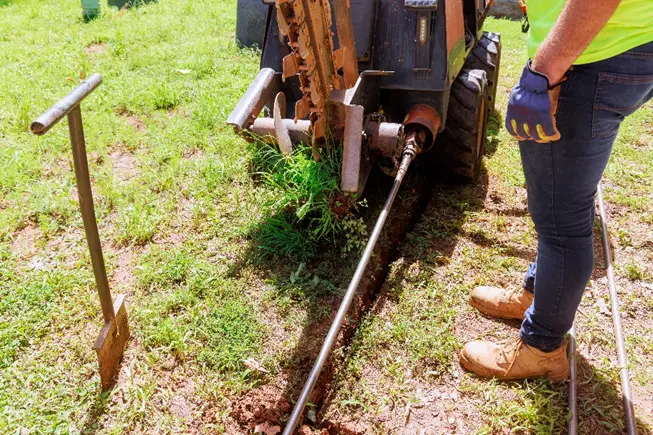
Municipalities across the U.S. have begun mandating pre and post directional drilling surveys/assessments to reduce or eliminate cross bores caused by trenchless technology telecom installations. GPRS can provide those assessments as part of our CCTV video pipe inspection services. Learn more about cross bores, here.
Priorities 3, 4, and 5 share the common thread of scale and acceleration of proven programs and practices based on “data-driven decision-making.” Look for Part 3 of this series soon to learn about those initiatives and how the CGA’s calls for expansion and quality control of data-centric practices and accurate utility mapping are being received in the industry.


